
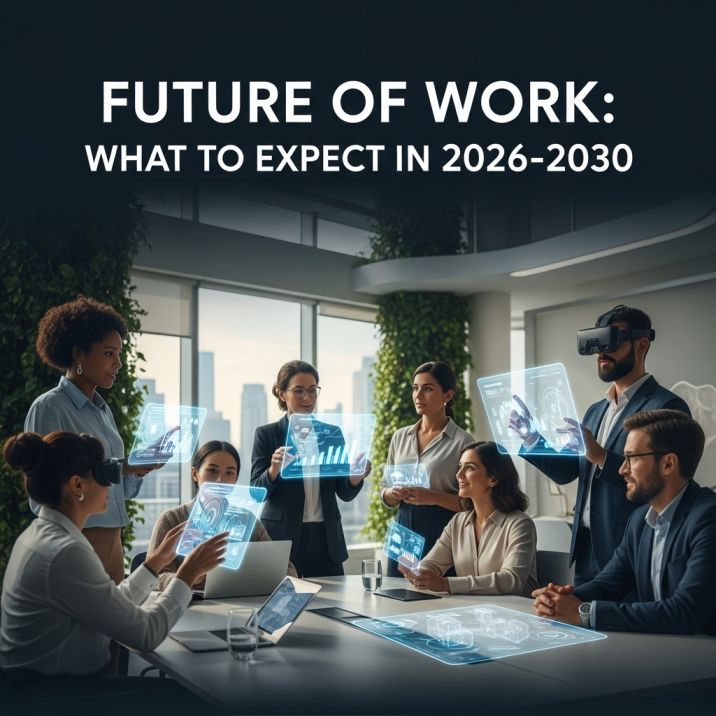
Stop waiting for things to “go back to normal.””Normal” left the building in 2020, came back for a short time in 2022 to get its coat, and is now officially gone. It’s the year 2026. Take a look around. In a good way and a bad way, the way we work has changed a lot. We’re not just making small changes to the old system; we’re starting from scratch and building a new one. The next four years (2026–2030) will be the most exciting yet.
We are leaving the “Industrial Age” of work behind and entering the “Outcome Age.” People don’t care how long you work anymore. They only care about what you make.
If you still think like you did in 2019, you’re going to get run over. This is the honest truth about what your job will be like in 2030.

1. 9-to-5
It’s funny to think that the only times to be productive are from 8:00 AM to 5:00 PM. Why should someone in Mumbai who likes to stay up late work the same hours as someone in London who likes to get up early?
“Async-First” will be the norm by 2030.
- In the past, we would say, “Let’s talk about this on Zoom.” (Takes an hour).
- New Way: “I made a 3-minute Loom video to explain the problem. Leave a comment after you watch it.
There will be bursts of work. You could work really hard from 8 AM to 11 AM, go to the gym, pick up your kids, and then work really hard again from 8 PM to 10 PM. The “Green Dot” on Teams/Slack won’t make a difference. The deadline will. The Risk: If you don’t build a wall, the line between “work” and “life” will completely disappear. The boss isn’t watching the clock anymore, so you have to keep track of your own time.
Similar More: AI Impact on Jobs, The Robots Aren’t Coming for You But Your Replacement Might Be
2. Office
Businesses that make people go back to the office five days a week are losing their best workers. But for many, the dream of “100% Remote” is also fading. We feel alone. We miss being with other people.
The office of 2030 is a place to go. You won’t go there to sit and answer emails with headphones on (you can do that at home). You will go there for “The 3 Cs”:
- Creativity: Writing down ideas on whiteboards.
- Connection: Lunches, drinks, and bonding with the team.
- Collaboration: Working together to solve problems that need face-to-face friction.
You will go to the office two days a week, not to “work,” but to “people.” You will stay home the rest of the week to get things done.

3. Portfolio Career
For 30 years, your parents worked at the same job. You could have five sources of income at the same time.
Asking someone “What do you do?” in 2030 will be a hard question. “I work part-time as a CMO for a startup, write a newsletter, rent out my basement on Airbnb, and give advice on AI strategy.”
This is what a Portfolio Career is. One employer can’t give you job security because they can fire you at any time. It comes from having three or four clients. You still have the other jobs if one fires you. A “Subscription Model” will start to look like full-time work. Companies will pay for your skills for a certain project and then stop paying when it’s done.
4. Degrees Are Out, Skill Wallets Are In
A four-year degree teaches you things that are no longer useful by the time you finish. Companies (even the big, stiff ones like banks and consulting firms) won’t care about your BA or BSc by 2030.
They will care about your “Skill Wallet.”
- Can you show me a collection of code?
- Can you show me the marketing campaign you did?
- Do you have a Google or Microsoft Micro-Credential?
The “Just-in-Time” learner will be the one who does well in the future. The person who can learn a new tool in a weekend will always beat the person who got their MBA 10 years ago. It’s not “Where did you go to school?” It’s “What have you made lately?”
5. Middle Management Meltdown
If your job is to ask your team “What’s the status of this?” and then tell your boss, it’s time to start packing. AI agents can keep an eye on things. AI dashboards can show metrics.
The “Supervisor” job is going away. “Coach” is the new job title. In 2030, leaders won’t be in charge of tasks (software will do that). They will be in charge of energy. They will be in charge of solving problems, stopping people from getting burned out, and keeping things running smoothly. You won’t be able to lead if you can’t do so with empathy.

6. Human
The value of skills like logic, math, coding, and writing goes down as AI gets better at them. What people want and what they can get. It doesn’t make sense to pay a junior lawyer $200 an hour to write a contract when ChatGPT-7 can do it in three seconds.
So, what costs a lot? Things that AI isn’t good at.
- Negotiation: Knowing when to push, reading the room, and sensing hesitation.
- Ethics: Choosing whether or not to build this, not just whether or not we can.
- Care: teaching, nursing, therapy, and coaching.
“Soft Skills” will be the most valuable skills by 2030. Your ability to get along with others will give you an edge over your competitors.
Others: 2026 में सरकारी नौकरी कैसे पाएं: वो सच जो कोचिंग वाले नहीं बताएंगे
7. Privacy vs. Productivity
This is the bad side. Bosses are getting paranoid because they can’t see you. There will be a war over Employee Surveillance. “Productivity scores,” eye-tracking, and keystroke loggers.
There will be two kinds of businesses:
- The Panopticons: They watch everything you do. (Avoid these).
- The Trust-Based: They look at the results. (Do these things).
You need to figure out how much privacy you’re willing to give up for a job.
Final Thoughts
There won’t be flying cars in the future of work. It’s actually much more basic. It’s time to go back to Output. It’s about getting back control of time.
The time of “acting busy” is over. The time has come to “get stuff done and then go for a hike.” There will be a lot of mess. It won’t be stable. You will have to work harder than your parents did. But you will also have more freedom than they ever did.
FAQs
Q: If the 9-to-5 is over, does that mean I work all the time?
A: If you don’t have any limits? Yes. One risk of “Async Work” is that you might check Slack at 11 PM just because you can. You don’t need to learn how to manage your time; you need to learn how to manage your boundaries. You have to close the laptop. If you don’t, the work will fill every waking hour. Now, you are your own union representative.
Q: “Portfolio Career” sounds like a lot of work. Can’t I just get a normal job?
A: You can, but it’s dangerous. Think of it as putting money into something. Putting all of your money into one stock is risky. Putting all of your income needs into one job is the same. You don’t need five side jobs, but you should probably have at least one backup income stream, like consulting or a digital product, just in case your “normal job” decides to “restructure” you out the door.
Q: I’m a manager in the middle. Is AI really going to fire me?
A: If your job is just to pass information from the bottom to the top? Yes. That job is over. You need to switch from “Supervisor” to “Unblocker” to stay alive. Don’t ask for updates; instead, ask, “What is stopping you from finishing this, and how can I help?” The value is in fixing problems, not just talking about them.
Q: Is my degree from college now completely useless?
A: It’s not worthless, but it’s not a golden ticket either. It’s just a “participation trophy” that lets you get through the first filter. No one cares after that. Don’t take it easy just because you’re an alum. A 19-year-old who learned on YouTube will take your place if you graduated five years ago and haven’t learned anything new since then.
Q: How can I tell if my company is spying on me?
A: Follow your gut and your task manager. Do you have software like “TimeDoctor” or “Hubstaff” that takes screenshots of your desktop? Go. That is a culture of fear. A business that treats you like a criminal will never treat you like a partner. Find a place that counts results, not clicks.