
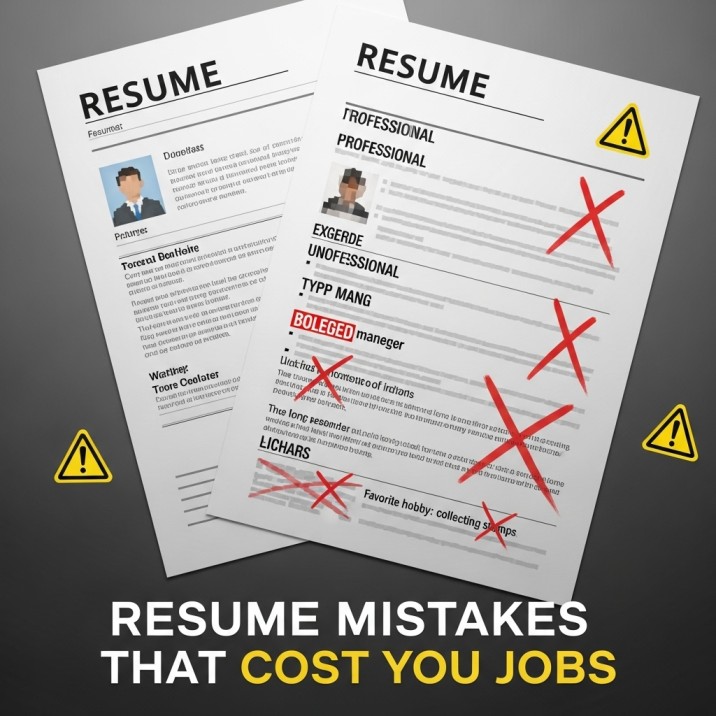
Sometimes we make a lot of resume mistakes that get us turned down. I’m going to be honest with you because no one else will. Your friends will say that your resume looks “great.” Your mom will say it looks “professional.”
But they aren’t the ones who will hire you.
I have looked at thousands of resumes. A lot of them are junk. Not because the candidate is bad, but because they keep making dumb mistakes that get them turned down in less than five seconds.
Yes, five seconds. That’s about how long a recruiter looks over your CV before deciding to read it or click “Next.”
If you’ve been applying for jobs for months and only getting silence (or those automated “Thank you for your interest” emails), you probably did at least three of the things on this list.
You need to fix these things on your resume right away.

1. Canva Template
I understand. You want your resume to look nice. You go to Canva and choose a template with two columns, a nice sidebar for your contact information, and maybe some skill bars that show you are “90% proficient” in Photoshop.
You think it looks great. An Applicant Tracking System (ATS) would see it as a nightmare.
Before a person ever sees them, most companies use software to read resumes. These bots are known for having trouble reading complicated layouts.
- They can’t read text in boxes.
- Columns make them confused.
- They don’t know what a “skill bar” is. Seriously, what does “80% Leadership” even mean? Did you lead 80% of a group?
The Fix: Be dull. Use a layout with only one column. Text in black on a white background. It’s not a work of art; it’s a piece of writing. You don’t exist if the bot can’t read it.
Similar More: How to Write a Resume That Gets Interviews
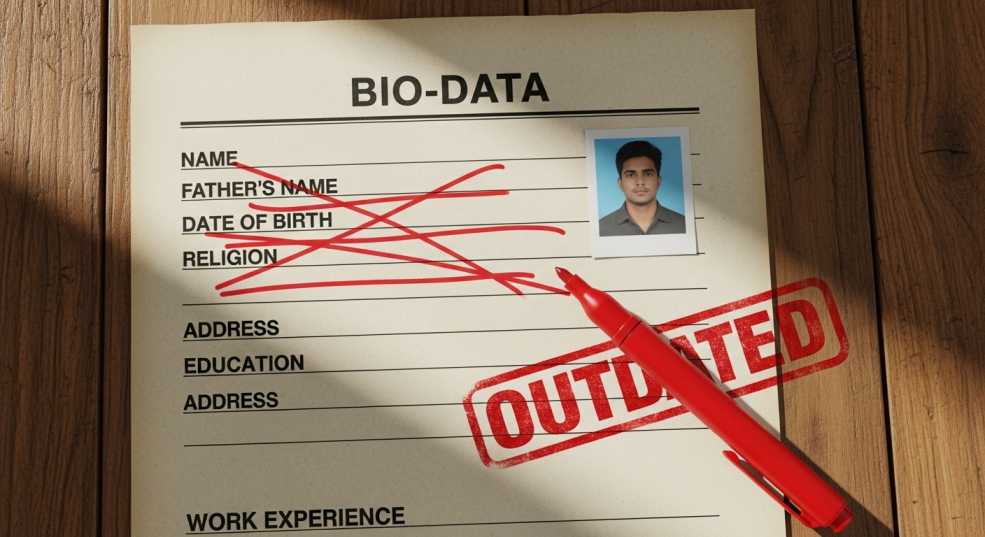
2. Including Your “Bio-Data”
I see this very specific mistake in resumes from our area. We learn in school how to write a “Bio-Data.”
So, people are:
- Father’s Name
- Marital Status
- Religion
- Full Home Address (down to the House Number)
- Date of Birth
Stop. Get rid of all of this.
In 2026, no private business will care about your father’s name or your religion. In fact, putting your age or picture on your application can hurt you because it makes it easier for people to be biased without realizing it.
Also, giving out your full home address is a security risk. You are sending this PDF to people you don’t know on the internet. Just the city and state are enough (for example, “Bangalore, Karnataka”).
3. Responsible For
Look over your “Experience” section. Does it look like this?
- Responsible for managing sales.
- Responsible for daily reporting.
- Responsible for team coordination.
This is the quickest way to put a recruiter to sleep. “Responsible for” only tells you what you have to do. It tells me what you were supposed to do, not what you did.
You could be “responsible for sales” and not make any sales.
The Fix: Switch to Action Verbs and Results.
- Change: “In charge of dealing with customer complaints.”
- To: “Handled more than 50 customer complaints every week, which cut down on refund requests by 15%.”
Do you see the difference? One is a job description, and the other is a brag. Your resume is a way to brag about yourself. Use words like “Created,” “Led,” “Built,” “Increased,” and “Saved” to start sentences.
4. Skill
I once saw a resume from a new graduate that included C++, Java, Python, HTML, CSS, React, Angular, AWS, Docker, Kubernetes, and Photoshop.
I asked him a simple question about Kubernetes. He looked at me with no expression.
If you list every piece of technology you’ve ever watched a YouTube video on, that’s a big red flag. It makes you seem like a liar. A recruiter knows that you can’t be an expert in 15 languages with only one year of experience.
The Fix: Only list skills that you can back up in an interview. If you only know the basics, write “Familiar with: [Skill].” It’s better to know a lot about three things than to be a “beginner” in twenty.

5. File Names Matter
Think about being a recruiter. You get 50 resumes. Resume.pdf or CV.pdf is the name of 40 of them.
Who is who?
I’m already annoyed if I have to open the file to see whose name is on it. Sending a file with a name like “John_Doe_Resume_TCS_Version.pdf” to a company that isn’t TCS is even worse. Oh no.
The Fix: Resume for FirstName_LastName.pdf. Easy. Businesslike. Simple to look up later.
6. Objective Statement
“To work in a challenging environment where I can utilize my skills and grow with the company.”
Ten thousand times, I have read this sentence. It doesn’t mean anything at all. It is text that fills space. It takes up the most important space on your resume, which is the top.
Recruiters don’t care about what you want, which is to grow with the company. They care about what they get.
The Fix: Get rid of the “Objective.” Put in a “Summary” instead. Please give me two or three lines that sum up your work life. “Five years of experience as a B2B SaaS marketing manager.” Increased organic traffic by 200% for two new businesses. That tells me exactly who you are and why I should keep reading.
7. Ignoring “Gap” Without Context
There are times when people don’t have jobs. You might have lost your job, gone on a trip, or had a health problem. That’s how it is.
But if your resume has a big two-year gap with no explanation, recruiters will think the worst. They think you were in jail or that you can’t get a job.
The Fix: You don’t have to write an essay. If the gap is big, just add a one-liner. “2024–2025: A break from work to learn more about data science and travel.” Take responsibility for it. Confidence solves everything.
Others: Resume कैसे बनाएं: एक ऐसा CV जो आपको नौकरी दिलाए, कूड़ेदान में न जाए
8. Typos
When someone lists “Attention to Detail” as a skill but then spells “Manager” as “Manger” or “Professional” as “Proffesional,” that’s my favorite mistake.
If you make spelling mistakes, it means you’re careless. If you don’t take care with your resume, which should be your best work, you won’t take care with your job.
The Fix: Don’t trust spell check. “Manger” is a real word, so spellcheck won’t catch it. Read your resume from the end to the beginning. Read from the bottom right to the top left, one word at a time. It makes your brain stop guessing the next word and look at how it’s spelled.
9. Adding References Upon Request
This phrase is from the 1990s. “References can be given on request.”
We understand. We will ask you for references if we need them. You don’t need to waste a line saying what everyone already knows.
The Fix: Get rid of it. Add one more bullet point about a project you did well in that empty space.
If you have more than ten years of experience, your resume should be no longer than one page. This means you need to cut things.
- That debate you won in eighth grade? Get rid of it.
- Your hobbies (unless they are really rare)? Get rid of them. Being human means “listening to music.”
Your Next Steps
Stay close. Make sure it stays relevant. If it doesn’t show that you can do this job, it doesn’t belong on the page.Right now, open your resume file. How many of these errors did you see? Make the changes, save it as a PDF, and then click “apply.”
FAQs
Q: But my Canva resume looks a lot better than one that is just plain text. Aren’t recruiters going to like the design?
A: What if a person saw it first? Maybe. But they don’t usually do that. First, a robot (ATS) scans it. Your “beautiful” resume goes right in the trash if that robot gets confused by your columns, icons, or skill bars. This happens a lot. Make it work for the software first, then for people. To stay in the running, keep it boring.
Q: In school, I learned to put my father’s name and date of birth on my CV. Why is it wrong now?
A: Things changed. That’s the old-school way of doing “Bio-Data.” In 2026, private companies won’t need to know your exact age or who your dad is to hire you. In fact, putting your age or religion on your profile gives people a chance to judge you before they even meet you. Just cut it.
Q: What if I don’t have exact numbers to show how well I did?
A: You don’t have to be perfect, but you do have to try. Instead of just saying “In charge of sales,” try to guess. “Managed a team of 5” or “Handled 20+ calls a day” is much better than a list of duties that isn’t very clear. “Responsible for” is not active. It sounds like you just got here. Action verbs show that you really did something.
Q: I know the basics of both Python and Java. Shouldn’t I list them to show that I can do a lot of different things?
A: Only if you want to fail the interview. I’m going to ask you about it if you put it on the list. You look like a liar if you can’t answer. It’s better to say you are an expert in three things than to say you are an expert in ten things where you only watched one tutorial. If you really want to include them, make sure to label them clearly as “Familiar with.”
Q: Is the name of the file really that important?
A: Yes. Think about the person who is hiring. The “Downloads” folder has 50 files in it. You are lost in the pile if your file is called “Resume_Final_v2.pdf.” If it’s called “Rahul_Sharma_Resume.pdf,” they can find you right away. Don’t make the recruiter work hard to find you.
Q: I took a year off to travel. Won’t that make it look bad?
A: It looks worse to hide it. If I see a space with no text, I might think you were let go and couldn’t find work. If you write “2024: Personal Travel and Sabbatical,” I appreciate your honesty. It shows that you are sure of yourself. Just take it.
Q: “References available upon request” is a common phrase. Why take it away?
A: Because it’s clear. It’s like saying, “You can call me if you want to.” We understand. Put something that really sells your skills in that space on the paper, like a project you worked on.
Q: What makes a “Summary” better than a “Objective”?
A: An objective is what you want, like “I want to grow…” A summary tells me what I’ll get if I hire you, like “Marketing pro who boosted sales by 20%.” Recruiters are selfish; they only care about what they can get out of it.