
A week is a strange amount of time. The first three days feel long enough to relax (“I have plenty of time!”), but then it’s suddenly the night before and you’re hyperventilating while trying to remember the company’s mission statement.
Please don’t do that.
Most people get ready for interviews in the wrong way. They learn general answers to general questions by heart. They say, “I am a perfectionist who works too hard.”
And then they ask themselves why they didn’t get the call back.
You have a huge advantage if you have a whole week. You have time to go deep. You have time to figure out what the company’s problems are and how to fix them.
This is your 7-Day Battle Plan for walking into that room (or Zoom) like you already own it.
Day 1 & 2:
Don’t look at the “About Us” page anymore. People look there all the time. It doesn’t tell you anything useful, just corporate nonsense.
You need to know what’s really going on with the company. You need to know what keeps the person in charge of hiring up at night.
Your Work:
- Read the news: Search for “News” and the name of the company. Did they just fire people? (Bad morale). Did they just get more money? (Growth mode). Did they just put out a new product?
- Follow the interviewers: Look for them on LinkedIn. Don’t just look at their job title. Check out what they’re doing. What articles do they like? What did they write about three months ago? If the Marketing Manager has been writing about “AI in content creation,” what do you think you should talk about in the interview?
- Look at the “Bad” Reviews: Visit Glassdoor. Don’t pay attention to the 5-star reviews; HR often makes them up. Look at the reviews with three stars. Most of the time, they are the most honest. When people complain about “micromanagement,” you should say that you are a “self-starter who sends proactive updates.”
The goal is that by the end of Day 2, you should know more than just what the company does. You should know what issues they are having.
Similar More: What to Wear to an Interview
Day 3:
The biggest mistake candidates make is trying to remember the answers to certain questions.
- “If they ask about conflict, I’ll say this…”
- “If they ask about leadership, I’ll say this…”
What is the problem? You freeze if they ask the question in a different way. You freak out because your script doesn’t fit.
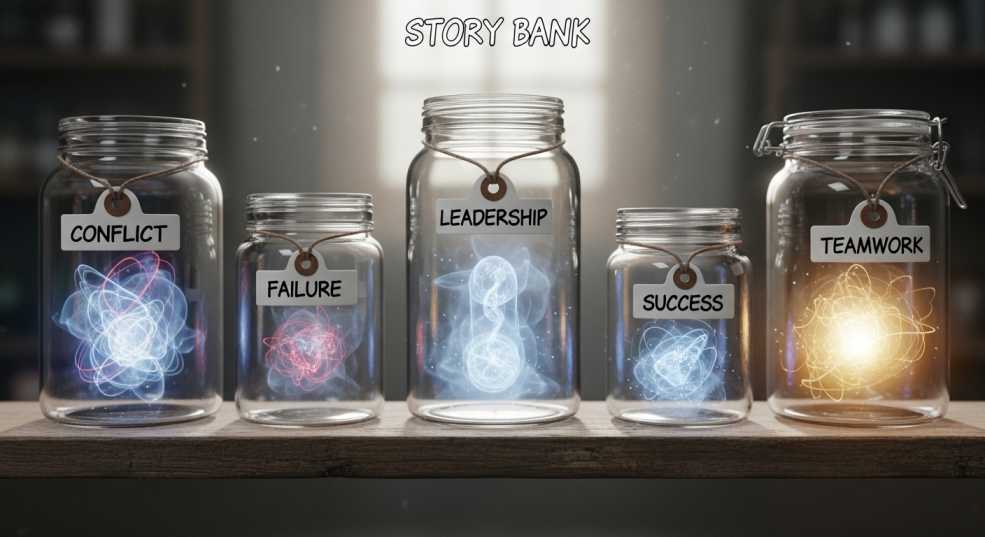
Instead, do this: Make a “Story Bank.” You only need five good stories from your work life to answer most behavioural questions.
- The “Disaster” Story: A time when something went wrong and you made it right.
- The “Conflict” Story: A time you and a coworker or boss didn’t see eye to eye in a nice way.
- The “Leadership” Story: A time when you led, even if you weren’t in charge.
- The “Lazy” Story: A time when you found a better or faster way to do something by hand
- The “Pride” Story: Your biggest victory.
Use the STAR Method (Situation, Task, Action, Result) to write these down. But pay close attention to the Action and Result. We don’t need five minutes of background. We need to know what you did and what happened as a result.
You can change these five stories to fit any question you have.
- What do you think is a challenge? Use the story of the disaster.
- What do you think is a weakness? Use the Conflict Story and what you learnt.
- What do you think about innovation? Use the Lazy Story.
Day 4:
They will ask this question first. It is 100% certain. A lot of people also mess up on this question.
They start reading off their resumes: “I was born in Delhi, then I went to college, and then I got my first job…”
Not interesting. The person who is interviewing you has your resume. They can read.
Your answer needs to be a business, not a biography. Put it together like this:
- The Hook: “I’m a [Role] who focusses on [One Main Thing].”
- The Highlight Reel: “I’ve been working with [Company] for the past X years, and I helped them [Big Achievement].”
- The Bridge: “That’s why I’m here. I love what you’re doing with [X], and I’d like to join your team and share my knowledge of [Y].
Don’t go over 90 seconds. Keep doing it until you can say it while you brew coffee.
Day 5: Mock Interview
You need to listen to yourself talk. In our heads, most of us think we sound clear. Then we say “Umm,” “Like,” and “You know” fifty times a minute.
The Test: Use your phone to open the voice recorder app. Think about this: “What is your biggest flaw?” Write down your answer.
Now listen to it again.
I promise you that you will feel bad. You will see that you went on and on. You will see that you didn’t really answer the question. This is a good thing. It’s better to cringe by yourself in your room than in front of a hiring manager. For 30 minutes, do this. Make your delivery better. Get rid of the extra stuff.
The “Weakness” Trap: Also, don’t say “I’m a perfectionist” when you practise the weakness question. Everyone hates that answer. Say something that is a real weakness but can be fixed.
- “I used to have a hard time speaking in front of people.” I would get very nervous when I had to give presentations to clients. Last year, I joined a club for people who want to improve their public speaking skills. “I’m not a pro yet, but I’m a lot more at ease now.”

Day 6:
They will say, “Do you have any questions for us?” at the end of the interview. If you say, “No, I think you covered everything,” you seem passive. It seems like you don’t care.
You have to talk to them. Get ready with three smart questions:
- “What does success look like in this job for the first 90 days?” (Shows that you are focused on your goals).
- “I saw that you just started [Project X]. What will this new job do to help with that? (Shows that you did your homework).
- “What is the hardest thing the team is dealing with right now?” (Shows you want to help).
Put these in a notebook. Yes, you should bring a real notebook to the interview. It makes you look put together.
Others: Interview की तैयारी कैसे करें, घबराहट को ‘कॉन्फिडेंस’ में बदलने का फॉर्मूला
Day 7:
It’s the day before. Stop reading. Studying a lot right now will only make you more anxious.
The Check of Logistics:
- Virtual: Check your internet if you’re virtual. Look at your lights. Make sure your background isn’t a pile of dirty clothes. Check your microphone.
- In-Person: Make three copies of your resume. (Yes, even if they have it on a computer. Giving someone a crisp paper copy is a power move. Press your shirt. Find out what’s going on with parking.
This is the most important part. It’s gross to walk into an interview with the attitude of “Please hire me, I need money.” It smells like need.
Final Thoughts
You need to have “Consultant Energy” when you walk in. Don’t think of this meeting as an interrogation; think of it as a business meeting.
- They have a problem, which is why the job is open.
- You are an expert who may be able to fix it.
- You are there to see if it works for both of you.
When you think like a consultant, you stop trying to “impress” them and start trying to “help” them. That change in confidence is usually what gets you the job offer.
FAQs
Q: I don’t have a week. I have an interview in the morning. What should I do?
A: Don’t panic yet. Pay attention now. Don’t do a lot of research on “company culture.” Spend 30 minutes on the site to learn about what they really sell. Then, for the rest of the night, work on your “Story Bank” (Day 3) and your “Tell Me About Yourself” intro. You can get by without the rest if you can tell a good story and introduce yourself clearly.
Q: Can I bring my notes with me to the interview? Or does that seem like cheating?
A: Bring the notebook. For real. It doesn’t seem like you’re cheating; it seems like you’re ready and taking the meeting seriously. You can write down your questions in it. You can even give your stories keywords, like “Conflict Story: The Shipping Delay.” Don’t read it like a robot, though. Take a quick look at it, then look them in the eye.
Q: What if I can’t find any “bad” reviews on Glassdoor?
A: You aren’t looking hard enough, or the company is new. It’s strange if there are no bad reviews at all. It could mean that HR is putting them on a list or filling the site with fake 5-star reviews. In that case, look for reviews that are “neutral.” Pay attention to what they don’t say. There probably isn’t a “work-life balance” if no one talks about it.
Q: I’m very anxious. How can I pretend to have this “Consultant Energy”?
A: It’s a job as an actor. Tell yourself, “I don’t need this job,” before you go in. I’m only here to see if I can help them. You have to act like you’re broke and desperate for 45 minutes, even if you really are. Sweat smells like desperation. Money smells like confidence. You can freak out in your car after the interview is over.
Q: What if they ask me something I didn’t plan for?
A: This will happen. Don’t get cold. Drink some water. It gives you five seconds to think. Then, go back to one of your five stories. If they ask you to tell them about a time you had to learn quickly and you don’t have a story, use your “Disaster Story” and say something like, “Well, I had to learn a new piece of software overnight to fix a disaster…” Turn to what you know.