
New York City, historically defined by frantic energy of Wall Street and creative pulse of Broadway, is currently undergoing a digital metamorphosis. While Silicon Valley has long held the crown as the world’s technology capital, tides are shifting. A surge in venture capital, a deep pool of academic talent, and the proximity to massive legacy industries are fueling a specific and explosive market: AI Engineer jobs in New York.
The narrative of the city is changing. It’s no longer just about bankers and brokers; it’s about prompt engineers, machine learning architects, and data scientists building the infrastructure of tomorrow.
For professionals looking to pivot or climb the ladder in artificial intelligence, Big Tech offers a unique ecosystem that blends pure tech with practical, high-stakes application in finance, media, and healthcare.
This article dives deep into the current state of the market, exploring where the opportunities lie, what skills are commanding top dollar, and how unique culture of NYC shapes the tech career trajectory.
Evolution of NYC’s Tech Ecosystem
New York’s tech scene often referred to as “Silicon Alley” has expanded far beyond the Flatiron District. Today innovation hubs are sprouting up from the Brooklyn Navy Yard to Long Island City. But density of opportunities remains highest in Manhattan, where established giants rub shoulders with scrappy unicorns.
Unlike the West Coast, where technology often exists for technology’s sake, New York is pragmatic. Machine Learning opportunities NYC has to offer are frequently tied to solving immediate, complex problems in established industries. For instance, hedge funds are deploying large language models (Known as LLMs in short) to predict market movements, while major media conglomerates are using generative AI to streamline content production.
This creates a more recession-resilient environment for engineers, as their roles are often tied to revenue-generating core business functions rather than speculative R&D.
Recent data suggests that while overall tech hiring has seen fluctuations globally, demand for specialized AI talent in New York has remained robust. Companies are not just looking for coders; they are looking for engineers who understand the business context of their algorithms.
Others: Crypto Jobs in 2026: The “Gold Rush” Isn’t Over, It Just Got Real

Key Players: Who is Hiring?
When analyzing tech hiring trends New York is currently experiencing, three distinct categories of employers emerge, each offering a different work culture and compensation package.
1. Financial Companies
Firms like JPMorgan Chase, Goldman Sachs, and strictly quantitative hedge funds like Two Sigma and Renaissance Technologies are massive consumers of AI talent. In these environments, AI engineers are often treated as front-office revenue generators. Work is intense, dress code is slightly more formal than a startup, and compensation is often significantly higher due to performance bonuses.
2. Big Tech Giants
Google, Amazon, Meta, and Microsoft all maintain a massive footprint in NYC. Google’s Chelsea market headquarters is effectively a city within a city. These roles offer stability and high base salaries associated with Silicon Valley, but with lifestyle benefits of living in New York. They are currently heavily focused on cloud AI services and integrating Generative AI careers into their existing product suites.
3. Startup Companies
New York is home to a vibrant startup scene, particularly in FinTech, HealthTech, and AdTech. Companies like Hugging Face which has a major presence in NYC are leading open-source AI revolution. Joining a startup here often means wearing multiple hats, lower cash compensation compared to hedge funds, but potentially life-changing equity upside.
Others: Nursing in Texas 2026: Salaries, Ratios, and Reality Guide
Skill Sets That Demand Top Dollar
Job title “AI Engineer” is broad, covering everything from data pipeline maintenance to designing novel neural network architectures. But in current NYC market specificity wins. Recruiters are moving away from generalist requirements and looking for deep expertise in emerging tools.
Proficiency in Python and frameworks like PyTorch or TensorFlow is now the baseline, not the differentiator. Current market places a premium on experience with Large Language Models (LLMs), Retrieval-Augmented Generation (RAG), and vector databases. Understanding how to fine-tune a model like Llama 2 or GPT-4 for specific enterprise data without leaking proprietary information is a highly coveted skill. And, because of the heavy influence of financial sector, knowledge of cloud infrastructure like AWS, Azure, GCP and containerization like Docker, Kubernetes is essential.
Startups vs Big Tech NYC debates often settle on one truth: in both environments, you need to know how to deploy your models, not just build them in a notebook.

Compensation: What to Expect
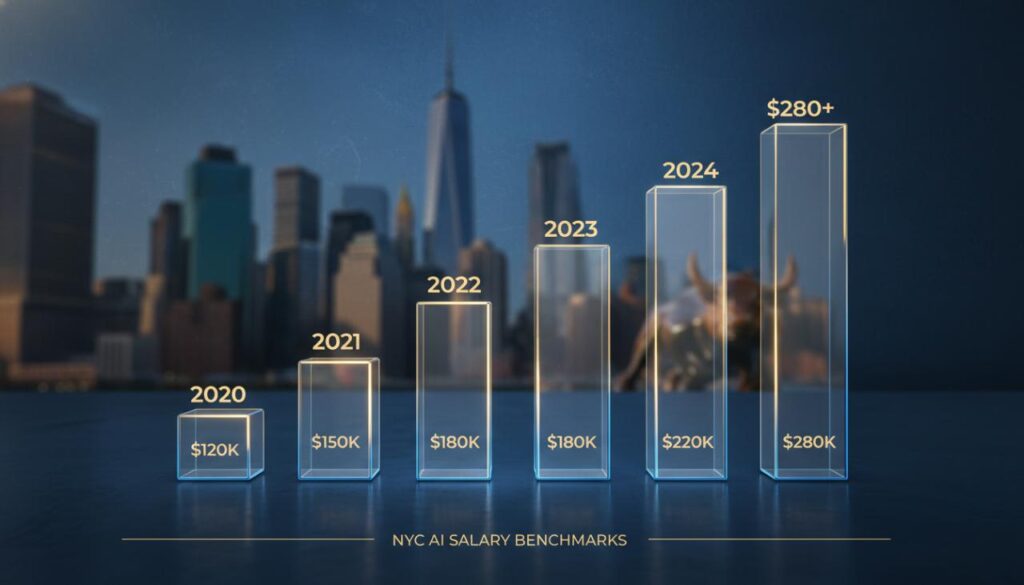
Living in New York is expensive, and salaries reflect that reality. AI salary expectations NYC professionals hold are among the highest in world, often rivaling or exceeding those in San Francisco Bay Area when adjusted for diversity of industries available.
For a Junior AI Engineer, base salaries typically range from $130,000 to $170,000. Mid-level engineers can expect between $180,000 and $250,000. Senior and Staff Engineers, particularly those with niche expertise in Generative AI or quantitative finance, frequently see total compensation packages (Base + Bonus + Equity) exceeding $500,000 annually. In elite quantitative finance sector, seven-figure packages are not unheard of for top-tier talent.
But candidates must look closely at structure of offer. Startups will lean heavily on stock options, which are high-risk, high-reward. Financial institutions will lean heavily on year-end cash bonuses, which are often performance-dependent.
Big Tech offers Restricted Stock Units, which provide liquid, public-market value.
Others: Business Analytics Jobs In Texas: Everything is Bigger in Texas, Including the Demand for Data Nerds
Networking and Community
One of distinct advantages of New York is density of network. Unlike sprawling campuses of Silicon Valley, NYC tech scene is vertical and concentrated. You can attend a meetup in SoHo, grab coffee with a VC in West Village, and interview at a skyscraper in Hudson Yards all in same afternoon.
Academic influence of institutions like NYU and Columbia University cannot be overstated.
These universities act as feeders for high-end research roles and host regular colloquiums that are open to the public. Engaging with these communities is often backdoor into unlisted job opportunities.
Regular events like NY Tech Meetup and specific AI-focused gatherings at spaces like the Cornell Tech campus on Roosevelt Island are essential for breaking into the inner circle.
In a city that runs on relationships, who you know is often as important as what you can code.
Interview Process in NYC
Interview culture in New York differs slightly from the West Coast. While you will still face the standard LeetCode style algorithmic challenges, there is often a heavier emphasis on system design and practical application.
For FinTech roles, expect questions that test your understanding of latency, throughput, and consistency.
A model that is 99% accurate but takes 5 seconds to run might be useless in high-frequency trading. Be prepared to defend your architectural choices and explain the trade-offs between different model types.
Behavioral interviews in NYC also tend to be more direct. Hiring managers want to know if you can handle the pace of the city.
Ability to communicate complex technical concepts to non-technical stakeholders (like traders or product managers) is a soft skill that is rigorously tested.
Others: Latest Updates on Upcoming Govenment Exams 2026: UPSC, SSC CGL, IBPS, TET, IBPS, Railway
Future Outlook and Regulation
Looking ahead, New York is pioneering not just in AI development, but in AI regulation. City recently implemented laws regarding the use of AI in hiring (Local Law 144), requiring automated employment decision tools to be audited for bias. This has created a sub-niche of jobs focused on AI ethics, compliance, and auditing.
Convergence of media, finance, and healthcare in a single geographic location ensures that AI Engineer jobs in New York will remain diverse.
As hype around Generative AI matures into practical implementation, the demand for engineers who can build reliable, production-grade systems will only increase. City is betting big on tech, and for savvy engineer, odds look good.

FAQ
What is the average salary for an AI Engineer in New York City?
Salaries vary by experience and sector, but Junior AI Engineers typically start around $130,000-$160,000. Mid-level roles often range from $180,000 to $250,000, while senior positions, especially in finance or big tech, can exceed $500,000 in total compensation.
Do I need a PhD to get an AI job in NYC?
While a PhD is highly valued for research-heavy roles at top labs like Google DeepMind or specialized hedge funds, it is no longer a strict requirement for most engineering roles. A strong Master’s degree or significant practical experience with LLMs and Python is often sufficient for application engineering roles.
Which industries in NYC are hiring the most AI engineers?
Financial Services sector is a massive employer, followed closely by Big Tech satellite offices, HealthTech, and Media/AdTech companies. There is also a rapidly growing ecosystem of pure-play AI startups.
Is remote work common for AI engineers in New York?
New York has a strong culture of in-person collaboration, especially in finance. Most companies operate on a hybrid model (3 days in-office, 2 remote). Fully remote roles exist but are becoming less common for high-paying core engineering positions.
What technical skills are most in demand right now?
Beyond Python and PyTorch, employers are aggressively seeking experience with Large Language Models (LLMs), Retrieval-Augmented Generation (RAG), Vector Databases (like Pinecone or Weaviate), and cloud deployment (AWS/GCP).
How does the NYC AI scene compare to Silicon Valley?
NYC is generally more focused on applied AI in industries like finance and media, whereas Silicon Valley focuses more on fundamental R&D and platform creation. NYC offers a more diversified economy, meaning tech is just one part of the city’s fabric.