
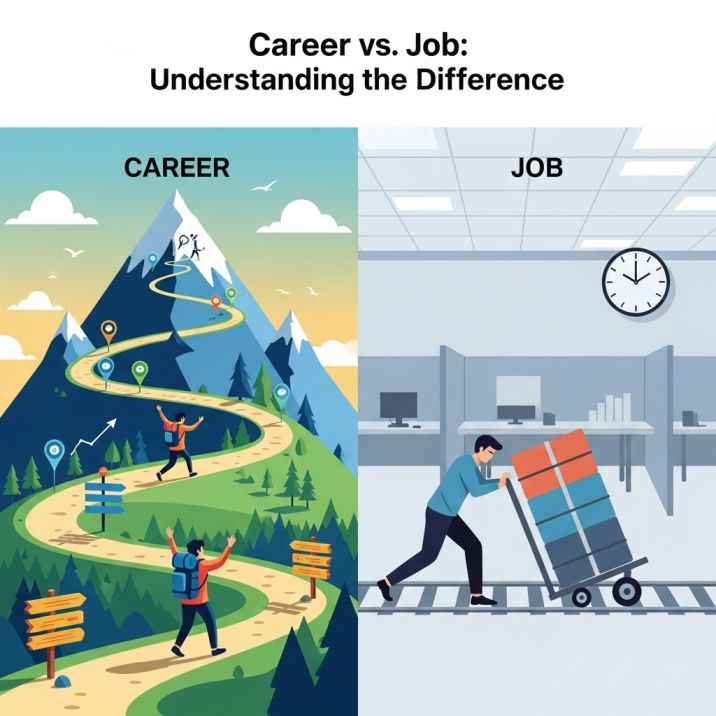
This question might ruin your day: If your boss stopped paying you tomorrow, would you still go to work on Monday?
Of course not. No one works for free. But here’s the bigger question: Would you still care about the work you did over the past five years if the money stopped? Would those years still mean something to you? Or would they just be a blur of time you lost and traded for rent money?
That’s the main difference between a job and a career.
People often use these words in the same way. When people say, “I’m focusing on my career,” they really mean, “I’m trying to get through my job.”
It’s dangerous to mix the two up. It causes two very specific kinds of pain:
- Treating a career like a job (which makes you stuck and bored).
- When you treat a job like a career, it hurts when they fire you.
If you feel like you’re running in circles, sweating, moving quickly, but not getting anywhere, it’s time to stop and look at the map. This is the brutally honest breakdown of the difference and how to tell which game you are really playing.

Job: Transaction Rent vs. Own
Let’s get rid of all the business talk. A job is just a simple money exchange. You have some time. The business has cash. You give them your time in exchange for their money.
That’s it. There is no deeper meaning. There is no “family.” It is a deal.
What a Job Is Like:
- Focus on the short term: your goal is to reach Friday. This week, the company wants to finish all of its tasks.
- Zero compounding means that the work you do today won’t make tomorrow easier. If you work as a cashier, scanning groceries today won’t make you faster or more useful next year. Every morning, you start over from scratch.
- Interchangeability: They can find someone to take your place in a week if you leave. You can find a job like the one you had in a week if they fire you.
- The “Paycheck Trap”: You only work to pay for things you do outside of work. The 40 hours you spend at work are the “tax” you pay to have a good time on the weekend.
Is it bad to have a “Job”? No! People start to judge here. There is no shame in working. If you are an artist who works as a waiter to pay for paint, then waiting tables is a job. It has a purpose. It pays for the dream. The issue arises when you believe your job is a career. You give it your all, work extra hours for free in the hopes of getting “loyalty,” and then they fire you over Zoom. That’s not what I expected.
Think of a job as a rental car. Keep it clean and drive it, but don’t upgrade the stereo. It’s not yours.
Similar More: Should You Take a Career Break? Pros and Cons
Career: Narrative Building a House
A job is not the same. A career is not just one job. It’s a series of jobs, projects, and learning opportunities that come together to make something bigger.
It works like compound interest. You should still be getting benefits from the work you did five years ago, but not in cash. Instead, you should be getting skills, a network, and a good reputation.
Things that make up a career:
- Long-term goal: You’re not working for the money today; you’re working for the job you want in three years.
- Skill Stacking: Each job gives you a new tool. You began your career in sales and then moved on to marketing. You are now a “Marketing Director who knows Sales.” That mix makes you hard to find and very valuable.
- Ownership: You don’t just own the tasks; you also own the results. You care about the business. You read about it on the weekends because you really want to know more.
- Resilience means that your career is fine even if you lose your job. In fact, getting fired could be an important part of your career story. The logo on your business card doesn’t make you valuable.

Gig Economy Lie
We should talk about the Gig Economy, which is a modern trap. Uber, DoorDash, and TaskRabbit. These are what marketing teams like to call “Flexible Careers.”
They are not telling the truth. These are the best jobs ever. If you drive for Uber for five years, you learn how to drive. You don’t make a network. You don’t learn how to be a manager. You don’t learn how to plan. If you stop driving after five years, you’re back where you started. You only have a broken-down car to show for it.
It’s great if you can pay your bills with gigs. But don’t fool yourself into thinking you’re “building a business.” You are selling time. That is a job.
Danger Zone:
The strangest thing is that you can have a job that pays a lot of money but hurts your career.
Think about being a middle manager at a boring old bank. You make $150,000 a year. You have to copy and paste data into Excel and go to three meetings a day where nothing happens. You are at ease. The cash is great. So you stay. You stay for ten years.
All of a sudden, the bank merges. You are let go. You go to the market and realize that your skills are ten years out of date. You were making a lot of money, but your “Career Equity” was going down the drain. You didn’t have a job; you had a very expensive one.
“Am I learning or earning?” is something you should always ask yourself. You are cashing out your career equity if you are making money but not learning. In the end, the account balance is zero.
Others: Defence Jobs: Army, Navy, Air Force की पूरी जानकारी , वर्दी सिर्फ कपड़ा नहीं, इमोशन है

How to Turn a Job into a Career
So, you’re stuck in a job. You want a job. How do you turn it on? You don’t have to quit right away. You just need to change how you think.
1. Stop thinking like an employee. Begin to think like a consultant. Even if you get paid, think of yourself as “Me Inc.” Your boss is just your current client. How can you help them so much that you get a great case study for your portfolio? Not every project is “work assigned by the boss.” It’s “a project I’m doing to show I’m good at X.”
2. Take the knowledge. Look around if you’re stuck in a dead-end job. Who is doing something cool? Talk to the salespeople. Go bug the engineers. Find out how the company makes money. Don’t just answer phones if you’re a receptionist. Find out how the office works. Get to know the CRM software. Take everything you can learn that isn’t nailed down. You will always have that knowledge.
3. Make the Network, Not the Tenure. Tenure (staying for ten years) used to be a sign of honor. If you haven’t grown, it’s a red flag now. Put your attention on relationships. In ten years, the person next to you could be the CEO of a company. Act like it. Your network is the only safety net that really works.
Final Thoughts
Take a look at your current job. Think about what it would be like to fast-forward five years. Will you be: A) More useful to the market? B) The same, but older and more tired?
You have a job if the answer is B. You need to start planning your escape or your evolution right now if you want a job. Don’t just pay rent; build the house. Life is too short.
FAQs
Q: Is it really bad to just have a job? I don’t want to work all the time.
A: No, it isn’t bad. It is true. It’s okay to work just to pay for your hobbies, your family, or your trips. The only time it’s dangerous is when you think you’re building a career but are really just treading water. If you’re okay with trading time for money with no growth, then own it. In ten years, you will be in the same place, so don’t be surprised.
Q: I get paid $100,000 a year, but I don’t do anything all day. Is that a job?
A: No, that’s a trick. We call them “golden handcuffs.” You are getting paid to sit around. It feels great now because the money is easy, but your skills are getting worse. You are in big trouble if that company goes out of business because you haven’t learned anything new in years. Enjoy the money, but if you don’t use your free time to learn new skills, you won’t be able to find a job.
Q: Can a job that pays well be a career?
A: Yes, of course. A plumber who learns the trade, then how to lead a team, and finally starts their own plumbing business is building a huge career. A plumber who has worked on the same leak for 30 years without learning anything new has a job. It’s not the color of the collar that matters; it’s the path.
Q: I’ve changed jobs every two years. Does that mean I don’t have a job?
A: That is a job in 2026. You are “Career Hacking” if every jump you make is a step up, like getting more money, a better title, or new skills. You’re taking information from other companies to make yourself more valuable. The old way was to stay in one place for 20 years. The new way is to move up.
Q: How do I let my boss know that I want a career and not just a job?
A: Don’t tell them; show them. Ask for projects that make you nervous. Say, “What is a problem that this team has that no one is fixing?” and then go fix it. If you treat the business like a client you want to impress, you stop being an employee and start being a partner. That’s how you move up in your job.