
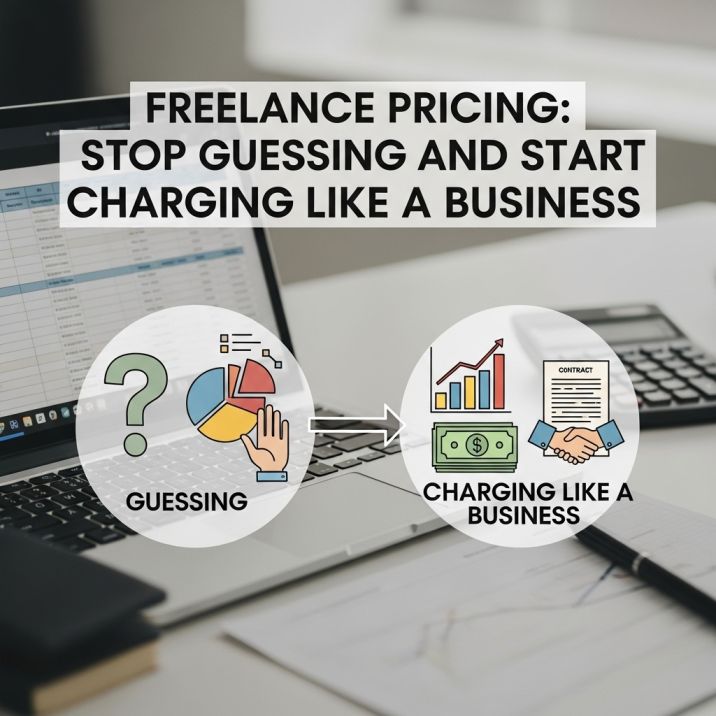
When you are talking to a possible client on Zoom. Everything is going well. They really like your portfolio. The vibe is good. Then, they drop the bomb: “So, how much do you charge?”, your heart stops. Your brain starts to do crazy, wrong math. Is $50 too much? Will they make fun of me? But am I cheating myself if I say $20? Should I just say $30 and see if they flinch?
You say a number without thinking. They say “Okay!” right away. And instead of being happy, you feel that sinking feeling in your stomach because you know you just lost money.
Welcome to the world of freelancing. Not because the math is hard, but because the psychology is messy, Freelance pricing is the hardest part of the game. We base our rates on how much we think we are worth, which is a recipe for disaster.
If you’re sick of working too hard and not charging enough, you need to stop setting prices based on how you feel and start setting them based on what is real. This is the no-nonsense guide to setting rates that really pay the bills.

1. Employee Mindset
This is the most common mistake freelancers make on their first day. They look at their old pay and try to match it. “Well, I used to make $30 an hour at work. So, if I charge $40 an hour as a freelancer, I get more money. “I’m rich!”
No. You’re out of money. Your boss paid for your health insurance, laptop, software licenses, internet, and taxes when you worked for them. They also paid you for the time you spent in pointless meetings and drinking coffee.
You pay for all of that as a freelancer. You also have “Unbillable Time.” You have to handle your own email, marketing, and billing. No one pays you for that. The Rule of Thumb: To keep the same standard of living, you need to charge at least 2.5 to 3 times what you pay your hourly workers. As a freelancer, you need to charge $75 to $90 an hour if you want to make $30 an hour as an employee. If you don’t get this much, you’re basically taking a pay cut.
Similar More: Time Zone Management for Remote Workers: How to Stop Living in “Jet Lag” Mode
2. Pricing Models
There are three ways to charge. Two are okay, and one is the “Holy Grail.”
A. Prices by the hour
Everyone starts here. “I charge $50 an hour.” It’s easy to get. Customers like it because it makes them feel safe. The Issue: It punishes people who are efficient. You get paid less if you do a task in an hour instead of five hours. Why should you be punished for knowing a lot? Use this only for vague consulting work where you don’t know what you’re doing.
B. Pricing Based on the Project
“I’ll write this blog post for $300.” This is better. The client is fully aware of what they are paying. You know exactly what you’re getting. Your effective hourly rate goes up if you work quickly. The Risk: Scope Creep. Your profit margin will disappear if the client asks for “just one more small change” ten times. To make this work, you need a strict contract.
C. Pricing Based on Value
This is how the pros get rich. You don’t charge by the hour. You charge the client based on the result you give them.
For example, a client asks you to write an email to sell something.
- Hourly Mindset: “I can do it in two hours, so it costs $100.”
- Value Mindset: “This email is going to 10,000 people.” If it works, you’ll make $50,000 in sales. I charge $2,000.
If the client makes $50,000, $2,000 is a good deal. It doesn’t matter how long it took you to write it. They are paying for the result, not the time.

3. How to Calculate Your Minimum Viable Rate
For a second, forget about what the “market rate” is. Let’s take a look at your life. You need to go back in time.
- The Goal: How much do you want to make each year? (e.g., $80,000).
- The Costs: Add 30% for taxes and 20% for running a business. (Total needed: about $120,000).
- The Time: You can’t charge for 40 hours a week. It’s not possible. You will get tired. Try to work 20 billable hours a week. That gives you 20 hours for sales, admin, and your own sanity.
- The Math:
- $120,000 divided by 48 weeks (with 4 weeks off) equals $2,500 per week.
- $2,500 divided by 20 hours equals $125 per hour.
That is your bottom line. If you charge less than $125 an hour (or the same amount for the project), you’re hurting your own goal. It’s easier to say the number out loud when you see the math.
4. Stating Your Price
You have your number now. Now you have to tell a person. This is where freelancers fall apart. They say, “So, um, I usually charge around… maybe $1,000?” But I can work with what you have.
Don’t do that. You just told the client that you don’t believe in your own price. The Plan:
- Shut Up: Say the price and then be quiet. “The project will cost $2,500 in total.”
- Hold on: There will be a pause. It will be strange. Don’t fill it. Don’t say you’re sorry. Let them have their own thoughts. The person who speaks first loses.
- Confidence: If you act like your price is a question, they will try to get you to lower it. They will respect it if you treat it like a fact.
Others: 2026 में बिना एक रुपया लगाए Online पैसे कैसे कमाएं?

5. Handling
It’s going to happen. A client might say, “Whoa, that’s way over our budget.” Don’t freak out. And don’t lower your price right away. If you go from $2,000 to $1,000 right away, you show that your first price was fake. You lose faith.
Instead, cut back on the Scope. “I know that budgets are tight. We can take out the second round of revisions and the SEO optimization if we want to lower the price to $1,500. “Does that work?”
This keeps your value safe. It says to the client, “I cost a lot because I do a lot.” You get less if you want to pay less.
6. When to Raise Your Rates
If every client says “Yes” to your price right away without asking questions, your prices are too low. You should be turned down 20 to 30 percent of the time. If you get rejected, it means you’re at the top of your market, which is where you want to be.
Trigger: For every three new clients you get, raise your rates by 10% for the next one. You will eventually reach the ceiling. But until then, keep going up.
Final Thoughts
It’s not about being greedy when you set prices. It’s about being able to keep going. If you charge too little, you’ll have to work more hours to make ends meet. Your work gets worse if you work more hours. You lose clients if the quality goes down. It’s a spiral of death.
Charge a fair price for your best work. Charge enough so you can sleep at night. The right clients will not only pay, but they will also respect you for it.
FAQs
Q: Should I show my prices on my website or keep them a secret?
A: It depends. Put it on the site if you sell a “productized” service, like “5 Blog Posts for $1,000.” It saves you time by getting rid of the cheap clients who can’t pay you. But what if you do complicated, one-of-a-kind consulting? Don’t turn it on. Before you can give them a price, you need to call them and find out what’s wrong. They’ll run away if they see “$10,000” without talking to you. They’ll pay if they hear the value first.
Q: A customer wants a discount for “Friends and Family.” Do I give it?
A: No. It’s already hard to work for friends; working for friends who are cheap is a nightmare. They will be the hardest clients you have. My rule is? Do it for the full price, or give it away for free. Resentment lives in the middle ground.
Q: I got the job done in half an hour. Should I really charge them the full price for the project? I feel bad.
A: Stop it. You aren’t going to charge for the 30 minutes. You’re charging for the five years it took you to learn how to do it in 30 minutes. You give the locksmith $150 if he can open your door in 10 seconds. You’re not paying for the 10 seconds; you’re paying to get into your house.
Q: The client wants it done by tomorrow. Do I have to pay more?
A: Of course. The “PITA Tax” stands for “Pain In The Ass Tax.” It costs twice as much if you have to cancel dinner plans or work late because they didn’t plan ahead. A rush fee of 50% to 100%. No exceptions. It teaches them to follow your schedule.
Q: What if I raise my prices and all of my current clients leave?
A: They might. And that’s fine. If you have 10 clients who pay you $50 each, you only need to keep 5 of them to make the same amount of money for half the work. You are letting go of the bottom half of your clients to make room for better ones. It’s scary, but it’s necessary for growth.