
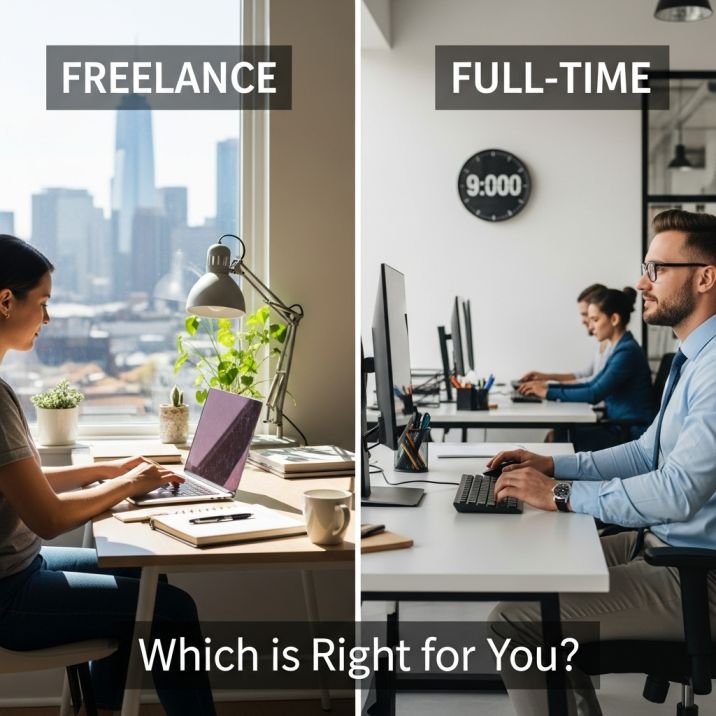
You probably want to quit your full-time job. You see people on Instagram working from a cafe as a freelance in Bali with a coconut in one hand and a laptop in the other. You think, “Why am I stuck here listening to my boss talk about ‘synergy’?”
But if you work for yourself, you probably envy your friends who work for someone else. You can see them clocking out at 5 PM, turning off their phones, and getting paid every week, no matter how hard they worked. You think, “I wish I could take paid time off.”
The grass is always greener on the other side. But in 2026, the wall that separates these two worlds will come down. It’s not just about money anymore; it’s also about your health and happiness.
I’ve done both things. I’ve worn the suit and worked in my underwear. There are great things about both, but there are also terrible things about both. If you’re on the fence about whether to jump in or stay safe, here’s the real, unfiltered breakdown of what you’re actually signing up for.

1. Full-Time Job
Let’s begin with the 9-to-5. Or, as I like to call it, “Adult Daycare.”
Good Stuff: Getting an SMS on the last day of the month saying, “Your A/C XX1234 has been credited with…” is the best feeling in the world. It’s addictive. It gives you a sense of safety.
- Paid Time Off: If you get the flu and stay in bed for three days, you will still get paid. That is amazing.
- Community: You have friends at work. You have friends to eat with. You can talk about other people with someone at the water cooler.
- Structure: You don’t have to make a choice every day. The business tells you. For some people, this is a good thing.
Bad Stuff:
- The Ceiling: You could work ten times harder than the person next to you and still get the same 5% raise. Your income has a limit.
- The Politics: Oh my god, the politics. Having to deal with a bad boss, going to meetings that could have been emails, and pretending to laugh at the CEO’s jokes.
- The Lack of Control: If the business loses money, you are out of a job. You think you have “Job Security,” but you really only have “One Point of Failure.” If that one employer fires you, you have nothing.
Similar More: Data Analysis Skills for Non-Technical Roles: Stop Letting the “Math Nerds” Have All the Fun
2. Freelance Life
Now, let’s talk about the Gig Life. The “Be Your Own Boss” dream.
Good Things:
- No Cap on Income: This is the best part. You can make twice as much money if you work twice as hard. You can raise your rates whenever you want to give yourself a raise.
- Location Independence: You can work from anywhere, even your bed. Do your job on a train. Do your work at your grandma’s house. You can do business as long as you have WiFi.
- You have the choice to fire a client if they are rude. You are the boss, so you don’t have to put up with a bad boss.
Bad Things:
- Feast or Famine: One month, you’re on top of the world. The next month, the phone stops ringing, and you’re eating instant noodles, wondering if you’ll ever work again. The worry never really goes away.
- You Are the Janitor: When you work as a freelancer, you do more than just the work. You are in charge of sales, IT, accounting, and human resources. Half of your time is spent doing taxes and chasing invoices.
- When you’re alone, things get quiet. Very quiet. You might not see or talk to another person for three days. This will drive you crazy if you are an extrovert.

3. Personality Test
Forget about the list of pros and cons. Your DNA is what makes this choice.
You should be in Full-Time if:
- You want to have a routine. You like to know exactly what your day will be like.
- You worry a lot about money. If you can’t sleep at night because you don’t know where your next check is coming from, freelancing will give you an ulcer.
- You are a social person. You need people to be around you to feel good.
- You have a hard time being disciplined. Will you just play video games all day if no one tells you to work? Be truthful.
You should be in Freelance if:
- You don’t like authority. If the phrase “because I said so” makes you angry, you can’t get a job. You need to be alone.
- You like to take risks. You are okay with the ups and downs. You believe in your ability to work hard.
- You are a generalist. You are good at a lot of things, like selling, doing, and organizing.
- You care more about time than money. You’d rather make less money and be able to pick your kids up from school at 3 PM.
4. Hybrid Option
No one will tell you this, but you don’t have to choose right now.
The best career path in 2026 is the Hybrid Model. Don’t quit your full-time job. Keep the pay. Keep the coverage. But begin working as a freelancer on the side. Nights and weekends.
Why?
- f you lose your job, you have a backup income.
- It’s a test drive: you can see if you really like freelancing without the risk of going hungry.
- It Gives You Power: If your side job pays as much as your main job, you can quit with a smile when you go to your boss’s office. Or, you could ask for a 4-day work week because you don’t need them anymore.
Others: Online Job कैसे खोजें

5. Job Security
One last look at reality. People say, “I want a full-time job because it’s safe.” Check out the tech layoffs that have happened in the last few years. Take a look at AI. There is no longer any job security.
You are selling your skills, whether you work for someone else or yourself. The only thing that is different is
- Employee: You only have one client, your boss. You will lose all of your money if you lose them.
- Freelancer: You have five clients. You lose 20% of your income if you lose one.
If you’re good at it, freelancing is actually safer in the long run, which is strange.
Final Thoughts
Don’t make either side seem better than it is. Work is work. A manager is your “boss” when you work full-time. The market is your “boss” when you work for yourself. Both can be hard.
Think about what kind of pain you like best. Would you rather be bored and deal with office politics? Do it full-time. Do you like the pain of not knowing and working hard? Do Freelance Work.
FAQs
Q: How much money do I need to save before I quit my job?
A: Six months’ worth of costs. At least. People will say three months, but that’s not true. Clients are late with payments. Projects take longer than expected. If you quit and only have three months’ worth of cash, you’ll smell desperate by the second month and take bad clients just to pay your rent. Start by making a “Freedom Fund.” It gives you the strength to say no to bad work.
Q: I’m not good at selling myself. Can I still work as a freelancer?
A: You can try, but it will hurt. Half of freelancing is doing the work and half is selling it. If you’re scared to ask for money or talk about rates, you’ll get crushed. You don’t have to be a “Wolf of Wall Street” salesman, but you should be able to say, “My price is $5,000,” without feeling bad about it.
Q: What about health insurance? That’s the only thing stopping me.
A: There is no trick here. You have to buy it on your own. It costs a lot. It stinks. But think about it this way: your boss wasn’t giving you insurance because they were nice; they were taking it out of the money they could have paid you. You can now see the bill right away. Include it in your hourly rate. You aren’t charging enough if you can’t pay for insurance.
Q: If I want to go back to full-time work later, will having a gap on my resume hurt me?
A: No. It really does help. Don’t call it a “gap” if you work as a freelancer for two years and then go back to work. Name it “Running a Consulting Business.” Companies like to hire people who used to work as freelancers because they know how money works. They know you work hard. You are not a failed employee; you are a skilled business owner.
Q: Can I just do freelance work on the side to avoid paying taxes?
A: Sure, if you want to go to jail. The IRS (or your local tax man) has better software for keeping track of things than you do. Don’t be dumb. Put 30% of every check you get into a different savings account right away. Don’t touch it. You don’t own that money; you’re just keeping it for the government.