

It usually comes on Sunday night. You’re trying to watch Netflix and eat pizza, but you feel like there’s a heavy rock in your chest. You check the time: 8:00 PM. Then, at 9:00 PM. Every hour that goes by brings you closer to Monday morning, and the thought of going to work or logging onto that Zoom call makes you want to scream into a pillow.
You know it’s time to go. You’ve known it for a long time, maybe even years. But you don’t move; you stay still. Why? Because it’s better to know the devil than to not know him. You think, “What if I don’t make it? What if I don’t have any money? What if I’m too old? What if I look dumb?”
If you’re reading this, you aren’t just “thinking” about changing jobs. You really need one. But fear has you in its grip. Let go of that grip now. We’re not going to talk about “following your passion” with stars in our eyes. When you have bills to pay and a reputation to protect, we’re going to talk about the messy, scary, real work of changing direction.
This is the plain truth about getting over the fear of starting over.

1. Acknowledge
This is the main reason smart people stay in jobs they hate. You say to yourself, “I went to law school for four years. I can’t stop now. I’ve worked in Marketing for ten years, moving up the corporate ladder. I’m throwing it all away if I leave.”
This is known as the Sunk Cost Fallacy. The person who is addicted to gambling keeps betting because they have already lost $1,000 and want to get it back.
The truth is that those years are already over. You can’t get them back by staying and being unhappy for another ten years. You aren’t “wasting” your experience if you leave your job. You are putting it back together.
- A lawyer who becomes a writer isn’t starting from scratch; they’re already a writer who knows more about logic, argument, and structure than anyone else.
- An accountant who becomes a chef knows more about food costs and profit margins than any graduate of a cooking school. You bring your skills with you. You only leave your bags behind.
Similar More: Career Advice for Fresh Graduates
2. Fear of Being a “Beginner” Again
Let’s be real. You enjoy being the expert. You like it when you know the answer in meetings. You like it when people ask you for help. It makes you feel good about yourself.
When you change jobs, you go from being the “Big Dog” to the “Puppy.” You will ask dumb questions. You will mess up. You might have to report to a manager who is younger than you.
People are scared of this. We think of “seniority” as “worth.” But think about this: Is your ego worth your happiness? Would you rather feel “smart” at a job you hate or “challenged” at a job you love? Accept the mindset of a beginner. It really does feel free. No one expects you to be perfect when you’re just starting out. The stress goes away. You get to learn again. It’s the fountain of youth for your brain.

3. Money Monster
“But I have a loan!” “I have kids!” “I can’t afford to lose money!”
This is a reasonable fear. I’m not going to tell you to “jump and the net will appear.” That advice is not good. If you jump without a net, you fall on the ground.
Don’t give up your job today. Building a runway is the best way to get rid of the fear of being broke.
- The “Freedom Fund”: Save enough money to cover your basic needs for six months before you quit. When you know you can get by for six months without a paycheck, “panic” turns into “planning.”
- The “Side Hustle” Bridge: Don’t quit your job right away. Do the new thing on the weekends.
- Do you want to be a copywriter? On Saturday mornings, write for clients.
- Want to learn to code? Go to school at night. Before you stop doing the old thing, show yourself that you can make $1,000 doing the new thing. It’s not just about money; it’s also about trust.
4. Stop Asking for Permission
We grow up wanting to be liked. First from parents, then from teachers, and finally from bosses. When we want to switch careers, we unconsciously wait for someone to tap us on the shoulder and say, “Okay, you can now be a graphic designer.”
That person will never come. Your parents might not like the idea. Your friends might think you’re crazy for quitting a “stable job.” They are putting their fears on you. You are the one living your life, not them. You have to give yourself permission. You need to sign your own permission slip. At first, it feels strange and lonely, but it’s the only way to go.
5. What If I Regret It?
This is the last boss of fears. “What if I leave my safe job, try something new, and hate it even more?” “Then I’ll be both poor and dumb.
Okay, let’s watch that movie. Scenario A: You change. You lose. You don’t like it. You get another job as a result. You could go back to your old job (trust me, they’ll take you back). You have bruises, but you learned a big lesson. You made it.
Scenario B: You stay. You stay for five years. Then 10, then 20. You wake up at 65. You think about what could have happened. The outcome is regret.
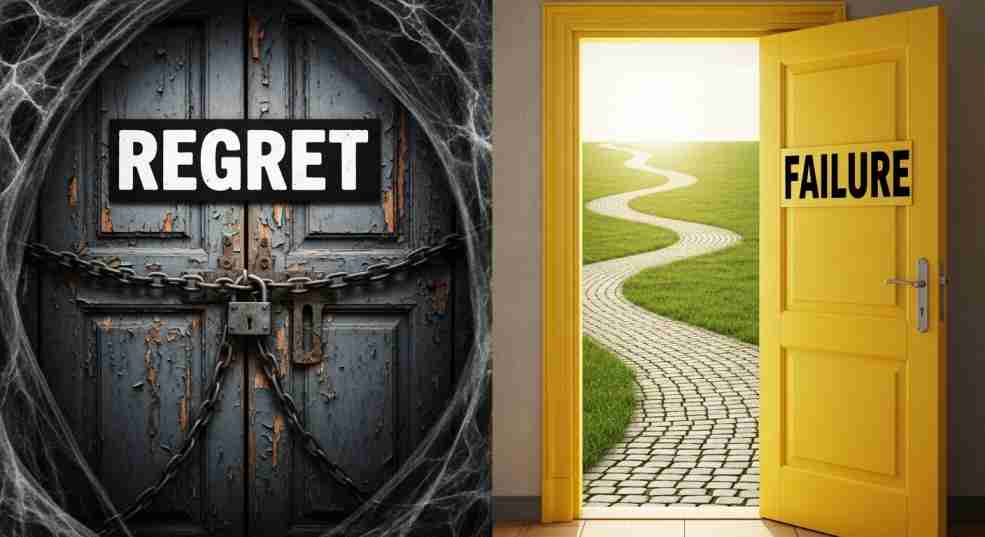
Failure is only for a short time. You can fix mistakes. You can find a new job. You can get your money back. But what about regret? Regret lasts forever. You can’t get time back. It hurts to try and fail, but it gets better. The pain of never trying is a dull ache that never goes away.
Others: Graduation के बाद सरकारी नौकरी, डिग्री मिल गई, अब कुर्सी कैसे मिलेगी?
6. Anxiety
Fear is something that happens in your mind. It feels like climbing Mount Everest when you sit on the couch and think about changing jobs. But the fear goes down when you take a step.
Don’t even think about “Changing Careers.” That’s too much. Do one little thing with your body today.
- Change the title of your LinkedIn page.
- Send an email to someone in that field asking them to meet for coffee.
- Check out a YouTube video that teaches you the new skill.
Fear can be fought with action. You stop overthinking as soon as you start moving.
Final Thoughts
You are not a tree. You aren’t stuck in one place. You are a person who can change. You shouldn’t let the 22-year-old version of you who chose your current job be in charge of the 35- or 40-year-old version of you. You have grown. You are different now. Your job should change as you do. It’s going to be scary. When you give in your resignation letter, your hands will shake. But on the other side of that door is the person you haven’t seen in a long time.
FAQs
Q: What if I switch jobs and hate the new one too?
A: You quit that one too. No joke. We act like career choices are like marriage contracts, but they aren’t. They are seeing each other. If you switch to Graphic Design and find out you don’t like working with clients, you switch to UX Design. If you don’t like that, you try being a product manager. You don’t want to be “perfect” the first time; you want to be “better.” It’s just data that you took the wrong turn.
Q: My spouse/parents think I’m crazy for leaving a “good job.” What should I do about that?
A: Stop trying to convince them with feelings (“I’m unhappy”) and instead give them a plan. When someone says “I’m quitting,” people freak out. When they hear, “I have three freelance clients lined up, six months of savings, and I’ve taken a course,” they relax. If you show them the safety net, they will usually calm down. What if they don’t? Do it anyway. You are the one who lives it.
Q: I’m [30/40/50]. Is it really too late, or is that just something people say to be nice?
A: Do the math. If you’re 40, you probably have to work until you’re 70. That’s thirty years. That is a whole other life. You may have been working for 18 years. You still have a lot of work to do. Do you really want to be unhappy for the next 30 years just because you were unhappy for 18 years? That’s not logical. You aren’t too old; you’re just halfway there.
Q: Is it possible to quit cold turkey without any savings? I’m in a lot of trouble.
A: You can, but I wouldn’t suggest it. Money problems kill creativity. It’s hard to do a good job in an interview when you’re worried about paying the rent next week. You smell like you need help. If you need to leave now for your mental health, get a “bridge job.” You could wait tables, drive for Uber, or work at a coffee shop. Anything that keeps the money coming in while you plan the big move.
Q: How do I write about a complete career change on my resume? Isn’t that going to make me look flaky?
A: Not if you frame it the right way. Don’t say you’re sorry. Take ownership of it. Your cover letter shouldn’t say, “Sorry, I don’t have any experience.” It should say, “Because of my experience in [Old Job], I have a unique advantage in [New Job] because I know [Skill] better than most beginners.” Help them see the big picture.