
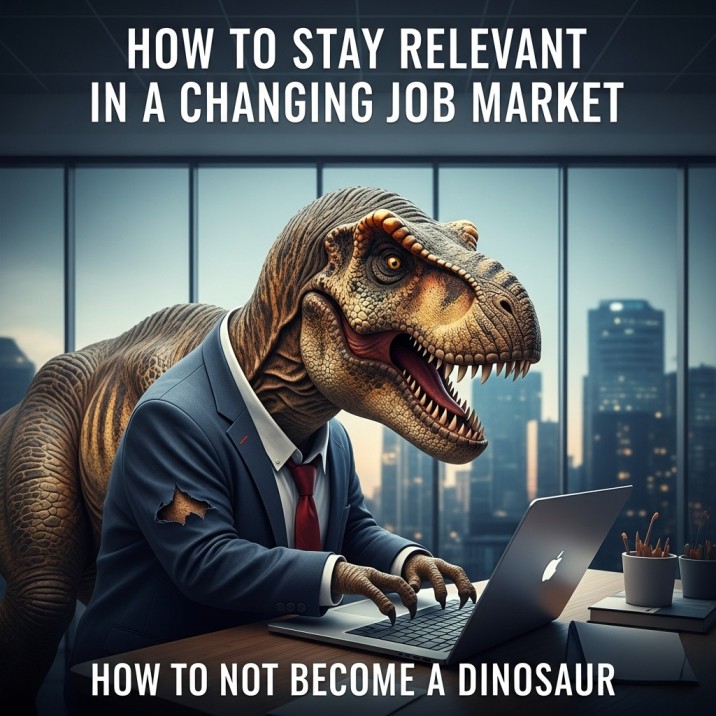
People often work for the same company their whole lives, but they don’t stay relevant in a job market that is always changing. Do you remember when we thought we knew everything? You went to college, got a degree, found a job, worked hard for 40 years, and then retired with a nice watch. That script is dead, buried, and gone. It feels like a panic room when you open LinkedIn these days. “AI is taking over!” “Tech layoffs are back!” “You have until next Tuesday to learn these 50 new tools, or you’ll be out of date!”
It’s tiring. You are doing your job, but in the back of your mind, a little voice is asking, “Will I still matter in five years?” Or am I going to be like those people who didn’t want to learn how to use email in the 1990s?
Hey, I’m not here to scare you. The fear-mongering is at an all-time high right now. But I’m here to tell you that the rules of the game have changed. The ladder is no longer there; it’s now a jungle gym. You can’t just keep your head down and “do your job” if you want to stay in the game.
Here is the plain truth about how to stay relevant when things keep changing.

1. Stop Trying to Out-Robot the Robots
This is where everyone messes up. People see AI writing code or making ads and think, “Oh no, I need to be faster than the AI.”
No, you can’t. You will always lose that race. Computers are faster, cheaper, and don’t need to take breaks for coffee.
You’re in trouble if all you can do at work is “I can process data quickly” or “I can write basic emails.” To stay relevant, you don’t need to be more technical; you need to be more human.
What can’t software do?
- It can’t calm down a client who is yelling on the phone.
- It can’t get a project approved because of all the political drama in the office.
- It can’t motivate a group of tired people and lead them.
Your “Soft Skills” (I hate that word; let’s call them Power Skills) are your safety net. These are the things that won’t go away during a recession or be taken over by robots: empathy, negotiation, storytelling, and solving hard problems. Don’t just be the person who collects the dots; be the person who connects them.
Similar More: Career Transitions After 40: What You Need to Know
2. The Art of Unlearning
We talk a lot about how to learn new things. The word “upskilling” is all the rage right now. But no one talks about how hard it is to break old habits.
What you don’t know isn’t the biggest threat to your career. What you think you know is no longer true.
- “This is how marketing has to be done.” (Not anymore).
- “You have to be at work to get things done.” Not true.
- “Experience is the same as seniority.” (Nope, being able to adapt means being senior).
People who hold on to the “glory days” are the ones who get left behind. They are the ones who say, “We did it this way in 2015.” Don’t be that way. Say, “Okay, the old way is over.” What is the new way? It doesn’t need any ego. It hurts a little to say that you’re a beginner again. But it’s better to be a beginner than a fossil.

3. Become a Swiss Army Knife, With One Sharp Blade
For a long time, the only advice was to be either a generalist or a specialist. You need to be a strange mix of both now.
Think of it like the letter “T.”
- The wide bar shows how much you know. You should have a little knowledge about everything. If you work in marketing, you should know how sales work. You should know how to design if you are a coder.
- The vertical bar is where you really know what you’re doing. The one thing you are really good at.
When budgets get tight in a changing market, the “I only do one thing” people are the first to go. You are safe if you are a writer who can also edit video. You are a unicorn if you are an accountant who also knows how to make data look good. Put your skills on top of each other. Do the work of 1.5 people (in a good way) to make it hard to find someone else to do it.
4. Network Like a Human, Not a LinkedIn Bot
“Making connections.” Ugh. Just typing the word makes me shudder. It sounds like bad coffee and weird handshakes in a hotel conference room.
But in a market that changes quickly, your network is the only thing you can count on. When you lose your job, sending resumes to job sites is like throwing them into a black hole. You need someone on the inside to tell you, “Look at this application.”
But here’s the thing: You can’t make connections when you’re in a hurry. You have to build it even when you don’t need it. Stop sending requests to connect that say, “I’d like to add you to my professional network.” Just be friends instead.
- Answer people’s posts with real thoughts.
- Send a direct message to an old coworker just to see how they’re doing, with no other purpose.
- Eat lunch with people from other departments.
It’s not about getting contacts; it’s about building a good name. You are never really unemployed when people trust you; you are just “between projects.”
Others: सरकारी नौकरी Age Limit 2026: क्या आप Overage हो रहे हैं?
5. Start a Low-Stakes Side Project
I’m not telling you to start a side business and work until midnight. I’m telling you to play around.
Building something useless is the best way to learn about a new technology or field. Taking a class isn’t the best way.
- Want to know more about AI? Make a meal plan for your dog with it.
- Want to learn how to edit videos? Create a TikTok channel about gardening.
- Want to know more about coding? Make a simple website for the band of your friend.
You learn faster when you try things out without the stress of “making money.” You get dirty. And you know what? If your boss asks, “Does anyone know how this new tech works?” you can raise your hand and say, “Yeah, I messed with it last weekend.” That’s how you can look smart without even trying.
Final Thoughts
It’s not about freaking out to stay relevant. It’s not about reading 50 business books every year. It’s about being curious.
You start to die professionally the moment you stop being interested in how the world is changing. The second you say, “I’m too old for TikTok” or “I don’t need to know ChatGPT,” you are ending your career. Watch out. Don’t let your ego get too big. And don’t forget: being able to change is the only job security there is.
FAQs
Q: I’m 45 years old. Is ageism really what makes me worry about being “irrelevant”?
A: Let’s be honest: ageism is real. But a lot of the time, what looks like ageism is really “Refusal to Adapt-ism.” If you talk about how much you hate Slack and miss fax machines when you’re 45, you’re making yourself a target. No one cares how old you are if you’re 45 and the first one to try out new AI tools. They want you to solve problems. Don’t choose to be a dinosaur.
Q: Do I really need to learn how to code? People always say, “Learn to code.”
A: No. AI will write better code than a beginner human in 2026. You don’t have to be a programmer. You should know how to use technology. You don’t have to know how to build things from scratch, but you do need to know what tech can do. Be the architect, not the bricklayer.
Q: My company offers “training,” but it’s just boring videos. Does that count as learning new skills?
A: Hardly. Watching a compliance video from the 1990s isn’t learning; it’s just following the rules. You really learn when you break things. To learn new skills, start a messy project. Make a newsletter. Make a spreadsheet work on its own. Do something that might not work out. That’s where the real growth takes place.
Q: How can I “network” without feeling like a jerk?
A: Stop trying to “get” things from people. Change your way of thinking to “How can I help?” You are being a friend, not a leech, if you send an email that says, “Hey, I saw this article and thought of your project.” Being generous is the best way to network.
Q: Are any jobs really “safe” anymore?
A: No. We made up the idea of safety in the 20th century. Government jobs are safer, but they can still be cut or automated. The only real safety is being able to stand up. You can’t do anything if you’re scared of losing your job. You are invincible if you know you can get another one.