
You have probably looked up this list on Google a dozen times. It’s 2 AM and you’re sitting there freaking out, trying to remember scripted answers because you’re scared they’ll ask you something strange like, “If you were a fruit, what kind of fruit would you be?”
(Spoiler: The company might be a little crazy if they ask you that, but you still need to answer.)
It’s true that every interview feels different, but 90% of the questions are the same. They just change the words a little. Recruiters aren’t very creative. They have a list of things to do. You win if you know the list.
This is a list of the 50 interview questions you are most likely to be asked and the “human” way to answer them, not the “robotic script” way.

These Will Happen 100%
These are the first lines. If you get these wrong, the rest of the interview doesn’t matter.
1. Tell me about yourself.
- Don’t say things like “I was born in…” or “I like cricket.”
- Say, “I’ve been a [Current Role] for [Years]. I’ve been working on [Big Win] lately. I’m looking to move because [Reason you want this job]. Don’t go over two minutes.
2. Why do you want to work here?
- The Trap: “I need a job” or “The pay is good.”
- The Fix: “I’ve been keeping an eye on your company’s work on [Specific Project]. I like how you deal with [Specific Problem], and I think my experience in [Skill] would be a great fit.
3. What is your greatest weakness?
- The Trap: “I work too hard” (the humble-brag).
- The Fix: Be honest, but fixable. “I have trouble speaking in front of people sometimes. To get more comfortable with it, I’ve started leading the weekly team stand-ups.
4. Where do you see yourself in 5 years?
- The Fix: Don’t say “In your chair.” Say, “I want to be an expert at [Skill X] and maybe even lead projects that have to do with [Y].” Be ambitious, but stay grounded.
5. Why should we hire you?
- The Fix: This is the last thing you need to say. “I have the exact mix of [Skill A] and [Skill B] you’re looking for, and I showed in my last job that I could use them to [Result].”
Similar More: How to Prepare for a Job Interview in One Week
Behavioral
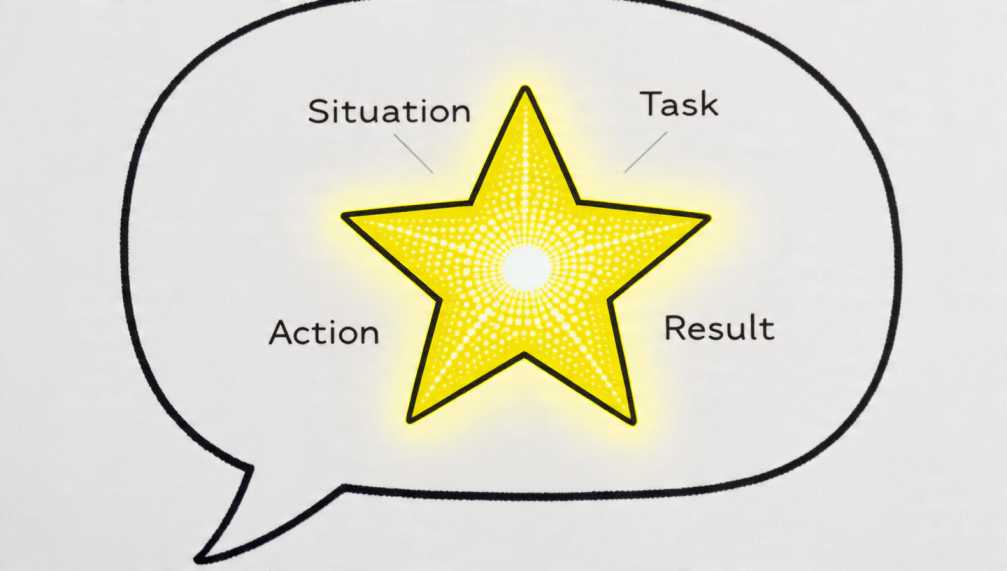
“Tell me about a time…” or “Give me an example of…” are the first words in all of these questions. Use the STAR method: Situation, Task, Action, and Result. Concentrate a lot on the Action (what you did).
6. Tell me about a time when you had to deal with a problem. (Talk about a technical problem or a deadline that is very close.)
7. Tell me about a time when you did something wrong. Take responsibility: “I missed a deadline because I didn’t talk to anyone.” This is how I fixed it and made sure it never happened again.
8. Tell me about a time when you had to deal with a hard-to-work-with coworker. (Focus on how you stayed professional, not how annoying they were.)
9. Tell me about a time you took charge. You don’t have to be a manager to be in charge. Did you set up a project? Help a junior?
10. Tell me about a time when you and your boss didn’t agree. (Show respect. “I showed data to back up my point of view, and we came to an agreement.”
11. Tell me about a time when you went above and beyond. 12. Tell me about a time when you were under a lot of stress. 13. Show me an example of a goal you met. 14. Give an example of a goal you didn’t reach. 15. Tell me about a time when you had to do more than one thing at once.
Why Are You Leaving? Questions
These are dangerous. Never badmouth your ex-employer.
16. Why are you quitting your job? (“I’ve learnt a lot, but I’m ready for a new challenge that my current job can’t give me.”)
17. What caused you to leave your job? (You should be honest. “I took time to learn new skills,” “I was taking care of a family member,” or “I took a planned career break.”
18. What made you lose your job? (If necessary. “It wasn’t the right fit.” I learnt that I do better in places that value X, which is why I’m here.
19. Why have you changed jobs so often? “I was looking for the right fit, and I think I’ve found it here.”
20. What was the worst part of your last job? “I wish there had been more chances to use [Skill you want to use now].”
Work Style Questions
21. What do you do when you’re stressed? (Gym? Lists? Meditation? Just don’t say, “I panic.”
22. Do you like to work alone or with others? A safe answer is, “I like both.” When I need to, I can focus on my work, but I love coming up with ideas with the group.
23. How do you keep things in order? (Trello, Notion, and Calendar blocking are some examples.)
24. What kind of work environment do you like best?
25. How do you deal with criticism? “I don’t take it personally.” I see it as data to work on.
26. What drives you? (Do you want to solve problems? Are you learning new technology? Don’t put money first; it’s implied.)
27. Tell me about the job you want. 28. What do you expect to make? (Do not give a number first. Find out how much money they have. Check out my other article about this!)
29. Would you be willing to move? 30. When can you begin?

Personality Test
31. What do you like to do in your free time? (Act like everyone else. “I like hiking” is better than “I collect rocks.”
32. What book did you read last? 33. Who do you look up to? 34. What sets you apart? 35. What kind of animal would you be? (Choose something that is smart or hard-working. Like a dolphin or a horse. Don’t say Sloth.
36. Give me this pen. (Focus on the need, not the pen. “Is there a way for you to write down this important thought right now?” No? “Here, take this.”
37. How many tennis balls can you fit in a limo? (They don’t care how many there are. They want to know how you think. “Okay, let’s guess how big the car is…”
38. What is your special power? 39. Use three words to describe yourself. 40. What are you most proud of?
Others: Interview में “अपने बारे में बताइए” कैसे Answer करें
“Do You Have Questions For Us?” (41-50)
Never say “No.” Ask these to look smart.
What does a normal day look like for someone in this job? 42. What are the team’s biggest problems right now? 43. What do you consider to be a success in this job? 44. How do people at the company get along? 45. What is the reason for this job opening? (It’s a new job or a replacement?) 46. What is the career path for this position? 47. In what ways has the business changed in the past year? 48. What do you (the person who is interviewing you) like best about this job? 49. What comes next in the interview process? 50. Is there anything about my application that worries you? This is a very bold ending. It lets you clear up any doubts they may have right away.
Final Thoughts
You don’t have to remember these words exactly. “Vibes” is what the interviewer is looking for. In a professional way. Are you sure? Are you able to talk? Do you really listen to what I’m asking?
You’re already ahead of 90% of the other candidates if you treat it like a conversation instead of an interrogation.
FAQs
Q: Do I really have to get ready for “Tell me about yourself”? Can’t I just go with the flow?
A: If you wing it, you’ll talk too much. I promise. You will lose them in the first 30 seconds if you start talking about where you grew up or your dog. This is your “elevator pitch.” Put it in writing. Set a timer. It has to be 90 seconds of “This is who I am, what I’ve done, and why I’m here.” It’s hard to fix things if you mess up.
Q: What if they ask a question that isn’t on this list?
A: Don’t worry. Breathe in. You can say, “That’s a great question; let me think about it for a second.” It gives you more time. A lot of “surprise” questions are just these 50 questions with a fake moustache on. Are they asking about your skills, your personality, or how you act?
Q: “What is your biggest weakness?” sounds like a trick. Is it?
A: Yes, it is a trap for people who lie. They know you’re lying if you say, “I work too hard” or “I’m a perfectionist.” You won’t get the job if you say “I’m lazy.” You need to find a balance. Choose a real weakness, like “I have trouble delegating,” and then tell the person right away how you plan to fix it.
Q: Can I bring notes to the interview?
A: Yes, of course. It really does look professional. Bring a notebook with your questions written down for them. You can also make a “cheat sheet” of your own accomplishments (just the keywords) to help you remember. Don’t read it like a script, though. Look at it for a second, then look them in the eye.
Q: How honest should I be about why I quit my last job?
A: Be honest, but polite. Don’t say “My boss was a nightmare” if your boss was a nightmare. “The way the management worked wasn’t a good fit for how I work best.” If you got fired? Say something like, “It wasn’t a skills match,” and then move on to what you learnt. Don’t talk trash. People talk in a small industry.
Q: Why do they want to know how many tennis balls fit in a limo?
A: They don’t care about the balls for tennis. They want to see if you get angry or if you try to figure out the problem in a logical way. They want to hear your brain work. Say out loud, “Okay, a limo is about X feet long…” It’s not a maths test; it’s a stress test.