
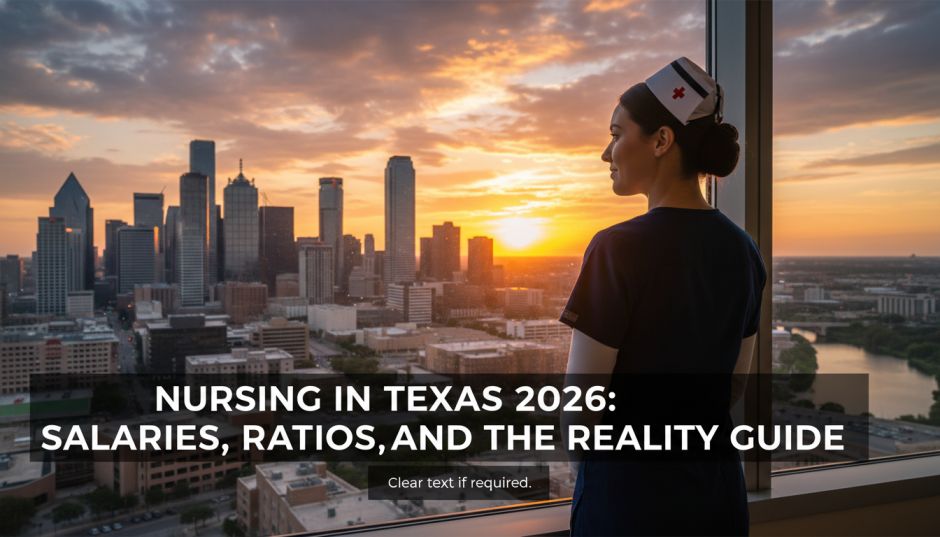
If you are working the floor as a nurse in 2026, you are probably tired. You are tired of unsafe ratios, tired of endless administrative hoops, and tired of looking at your paycheck and wondering where half of it went before it even hit your bank account.
That is usually specific moment when exhausted RNs start searching for nursing jobs in Texas.
Texas has quietly or loudly, depending on who you ask become the promised land for nurses over the last few years. It isn’t just about cowboy hats, Buc-ee’s stops, or brisket though the brisket definitely softens blow of a 12-hour shift. It is really about math. We are talking about a state with zero state income tax, a massive shortage of experienced clinicians, and some of the largest, most prestigious medical centers on the planet.
But before you pack your scrubs, buy a pair of boots, and rent a U-Haul, you need the full, unfiltered picture. Texas is massive. Working in a Level I trauma center in Houston is a completely different universe from running a rural clinic in West Texas. culture, pay, and stress levels vary wildly.
Here is your raw, expert guide to landing a job in Texas without losing your mind.
Other: Business Analytics Jobs In Texas: Everything is Bigger in Texas, Including the Demand for Data Nerds
1. Are You Actually Getting Enough Salary?
Let’s talk cash first, because that is why you are reading this. If you look at the raw numbers on a job board, a California nurse might laugh at a Texas offer. But that is a rookie mistake.
Average Texas RN Salary (2026): Roughly $75,000 to $95,000 base for staff nurses.
In major metros like Houston or Dallas, that number can easily push $100k+ once you factor in shift differentials, experience, and certifications.
“Wait,” you might say. “I make $120k in New York! Why would I take a pay cut?”
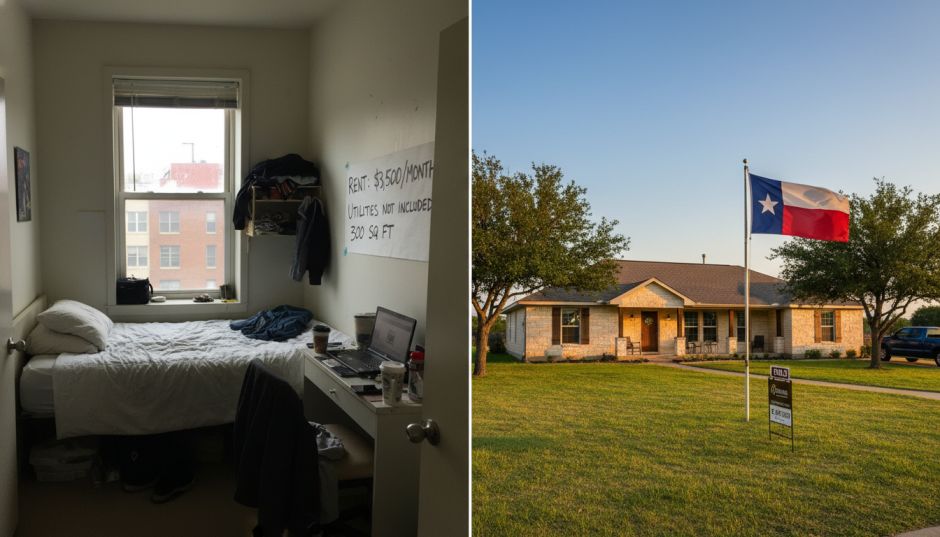
Here is reality check: In New York or California, you pay state tax, city tax, and perhaps $3,500 a month for a shoebox apartment that hasn’t been renovated since the 90s. In Texas, Uncle Sam takes his federal cut, but the state of Texas takes exactly $0 from your paycheck.
Plus, outside of Austin (which is its own economic bubble), housing is still purchasable by mere mortals. Your “take-home” pay the money you actually get to keep and spend—often goes significantly further here.
Strategy: Do not look at the gross pay. Look at the Net Pay vs. Rent ratio. That is where the Texas RN salary 2026 data really shines.
Others: California Remote Jobs: How to Get the ‘Golden State’ Paycheck
2. Pick Your Any From 4 Major Markets
Texas isn’t just one place. It is basically five different countries stacked inside a trench coat. You need to pick the city that fits your lifestyle and your career goals.
A. Houston Is Best For It
Vibe: Humid, massive, incredibly diverse, and widely considered center of medical universe.
Job: This is home to Texas Medical Center nursing scene. It is the largest medical complex in world. We are talking about giants like MD Anderson (Cancer), Houston Methodist, and Memorial Hermann. If you want to see rare pathologies, work with world-renowned surgeons, and have serious “Prestige” on your resume, this is where you go.
Catch: traffic is soul-crushing. You will spend a significant portion of your life on I-45. Plan your housing carefully to minimize the commute.
B. Dallas-Fort Worth For Corporates
Vibe: Flashy, polished, and full of suburban sprawl.
Job: You have massive systems here like Baylor Scott & White, UT Southwestern, and Parkland famous for being where JFK was taken. culture here is very competitive and corporate. pay is usually slightly higher here to compete with “corporate” cost of living and sheer size of metroplex.
Catch: It feels very “business.” It is generally less laid back than the rest of state.
C. San Antonio For Military Of USA
Vibe: Friendly, steeped in history, incredible tacos, and way more relaxed than Houston or Dallas.
Job: There is a huge military influence here, anchored by BAMC (Brooke Army Medical Center). If you are interested in trauma—specifically burns and battlefield-style trauma—this is the spot. Also, cost of living is notably lower than in Dallas or Austin.
Catch: Because cost of living is lower, pay offers tend to be slightly lower than Houston or Dallas.
D. Austin For Tech Person
Vibe: Tech bros, live music, expensive lattes, and outdoor fitness.
Job: Major players include St. David’s and Ascension Seton. It is a fantastic place to live if you are young, single, and love nightlife.
Catch: Rent is insane. traffic is bad And surprisingly, pay is often lower than Houston because everyone wants to live there. Hospitals know they can pay you in “vibes” and “sunshine.” Do not fall for it unless you really love the city.
3. How To Get A Compact License?
Here is some good news: Texas is a proud member of Enhanced Nurse Licensure Compact. This simplifies things drastically for many movers.
- If you live in a Compact State (like Florida, Arizona, Tennessee, or Georgia): You don’t even need to apply for a new license initially. You can just drive to Texas and start working on your multistate compact nursing license.
- If you are from a Non-Compact State (like California, New York, or Oregon): You need to apply for a “Texas License by Endorsement.”
Pro Tip: Do this before you move. Texas Board of Nursing is generally efficient, but you do not want to be stuck in bureaucratic limbo while your first month’s rent is due.

4. ADN vs. BSN: Do You Need Degree?
In 2026, “Magnet” status craze is still very real. Big hospitals—especially those in the Texas Medical Center heavily prefer Bachelor of Science in Nursing for nurses.
Can you get a job with an ADN (Associate Degree in Nursing)? Yes. Absolutely. This is especially true in rural areas, nursing homes, rehab centers, or community hospitals.
Loophole: Many big hospitals will hire you with an ADN if you sign a contract agreeing to get your BSN within 2-3 years. The best part? They often pay for it through tuition reimbursement programs. So, when debating ADN vs BSN Texas requirements, don’t let lack of a BSN stop you from applying. Just be ready to go back to school on their dime.
Others: Data Analysis Skills for Non-Technical Roles: Stop Letting the “Math Nerds” Have All the Fun
5. Rural Areas Are Best For Bonuses
If you want to make most money with least amount of competition, you need to leave major cities. West Texas like Midland, Odessa, Lubbock and Border region are desperate for capable nurses.
Why go there? Sign-on bonuses. We are talking $10,000, $20,000, sometimes even more just to sign dotted line.
Job: You will see everything. In a rural ER, you are often trauma team, psych nurse, and delivery nurse all wrapped into one. It makes you a rockstar clinician very quickly.
Reality: It is flat, dusty, and quiet. If you need a vibrant nightlife, you will be miserable. But if you want to stack cash for two years to buy a house outright, it is a goldmine.
6. Things That Recruiters Won’t Tell You
I promised no fluff, so here are cons you need to know before you sign.
Ratios: unlike California, Texas has no state-mandated patient ratios. In a good hospital, it’s fine. In a bad hospital, you might find yourself juggling 6, 7, or even 8 patients on a Med-Surg floor. Always ask about ratios during your interview. If they dodge the question or give you a vague answer, run.
Heat: It isn’t just “hot.” It is “melt your dashboard” hot from May to October. You will live a life of moving from your air-conditioned house to your air-conditioned car to air-conditioned hospital. You have to be okay with that.
Politics: Healthcare in Texas can get political. Reproductive health laws are strict here. Depending on your specialty like labor & delivery, women’s health, make sure you understand the legal landscape and hospital policies before you accept job.

7. How to Actually Land the Job
Don’t just hit “Easy Apply” on Indeed. That is a black hole where resumes go to die.
Target the System: Go directly to career pages of big systems: HCA Texas, Methodist, Memorial Hermann, Baylor Scott & White.
Residency: If you are a New Grad, you must get into a Nurse Residency Program. Nurse residency programs Texas offers open up months in advance usually February/March for summer starts. If you miss that window, you might have to wait six months for next cohort.
Network: Texans are friendly. If you find a nurse manager on LinkedIn and send a note saying, “Hey, I’m moving to Texas and love your unit’s focus on Neuro ICU,” they will likely reply. We value relationships over cold resumes here.
Others: Work Pressure कैसे Handle करें बिना पागल हुए
Final Thoughts
Texas isn’t perfect. traffic sucks, summer is brutal, and ratios can be heavy if you don’t vet your employer. But if you want to build a life where you can actually afford a house with a yard while working at some of best hospitals in the world, it is the place to be.
Just buy a good pair of sunglasses and learn to love phrase “fixin’ to.” Y’all ready to apply?
FAQ
What is the average RN salary in Texas for 2026?
average base salary for an RN in Texas in 2026 generally ranges between $75,000 and $95,000. However, in major cities like Houston and Dallas, experienced nurses can earn over $100,000 when factoring in shift differentials and overtime.
Does Texas have mandated nurse-to-patient ratios?
No, Texas does not have state-mandated nurse-to-patient ratios like California does. Ratios vary by hospital and unit, so it is critical to ask about specific unit ratios during your job interview.
Is Texas a compact nursing license state?
Yes, Texas is part of Enhanced Nurse Licensure Compact. If you hold a compact license from another member state, you can work in Texas without applying for a new single-state license.
Do I need a BSN to work in Texas hospitals?
While you can get a job with an ADN, especially in rural areas or smaller facilities, major Magnet-designated hospitals in the Texas Medical Center strongly prefer BSN-prepared nurses. Many will hire ADN nurses with a contract to complete their BSN within a few years.
What are the best cities in Texas for nursing jobs?
Houston is best for world-class medical center experience; Dallas is great for corporate healthcare systems and high pay; San Antonio is ideal for military and trauma focus with a lower cost of living; and Austin is popular for lifestyle, though pay is often lower relative to cost of living.
When should new grads apply for Texas nurse residencies?
New grad nurse residency programs in Texas typically open applications 3-4 months before start date. For summer cohorts, applications often open in February or March. It is essential to apply early as these spots are competitive.